
Are you planning to lay a new screed and wondering whether you’ll need steel mesh? Perhaps you’ve also heard of macro-fibres, which are mixed directly into the screed mortar. In certain cases, this makes it easier to reinforce the screed. However, not every screed requires reinforcement at all – and not every fibre can fulfil the same function.
The short answer: Structural macrofibres can provide useful additional reinforcement in suitable cement-bound screeds and, under certain conditions, can replace the planned steel mesh reinforcement. The key factors are the screed structure, the load, the layer thickness and the proven performance of the fibres. In the case of floating screeds, reinforcement in accordance with DIN 18560-2 is generally not required. Understanding these differences enables you to plan your project technically soundly and avoid unnecessary costs.
What does it mean to reinforce a screed?
Screed forms the level, load-bearing layer beneath tiles, parquet, vinyl or other floor coverings. Sometimes it serves as a finished floor surface in its own right, for example in a workshop. Depending on its construction, it may be firmly bonded to a subfloor, laid on a separating layer or installed ‘floating’ on a layer of insulation.
Stresses develop in cement screeds during hardening and drying. Subsequent loads, temperature fluctuations and movements in the sub-base also place stress on the layer. Reinforcement is not intended to prevent all cracks. Depending on the type of reinforcement, it can help to limit the development or width of cracks and influence the behaviour of a layer that has already cracked.
It is important to distinguish between a screed layer and a load-bearing reinforced concrete slab. A screed is not normally a substitute for a load-bearing structural element. What is permissible for a cement screed cannot therefore automatically be applied to a self-supporting slab or a load-bearing beam.
How do macrofibres work in screed?
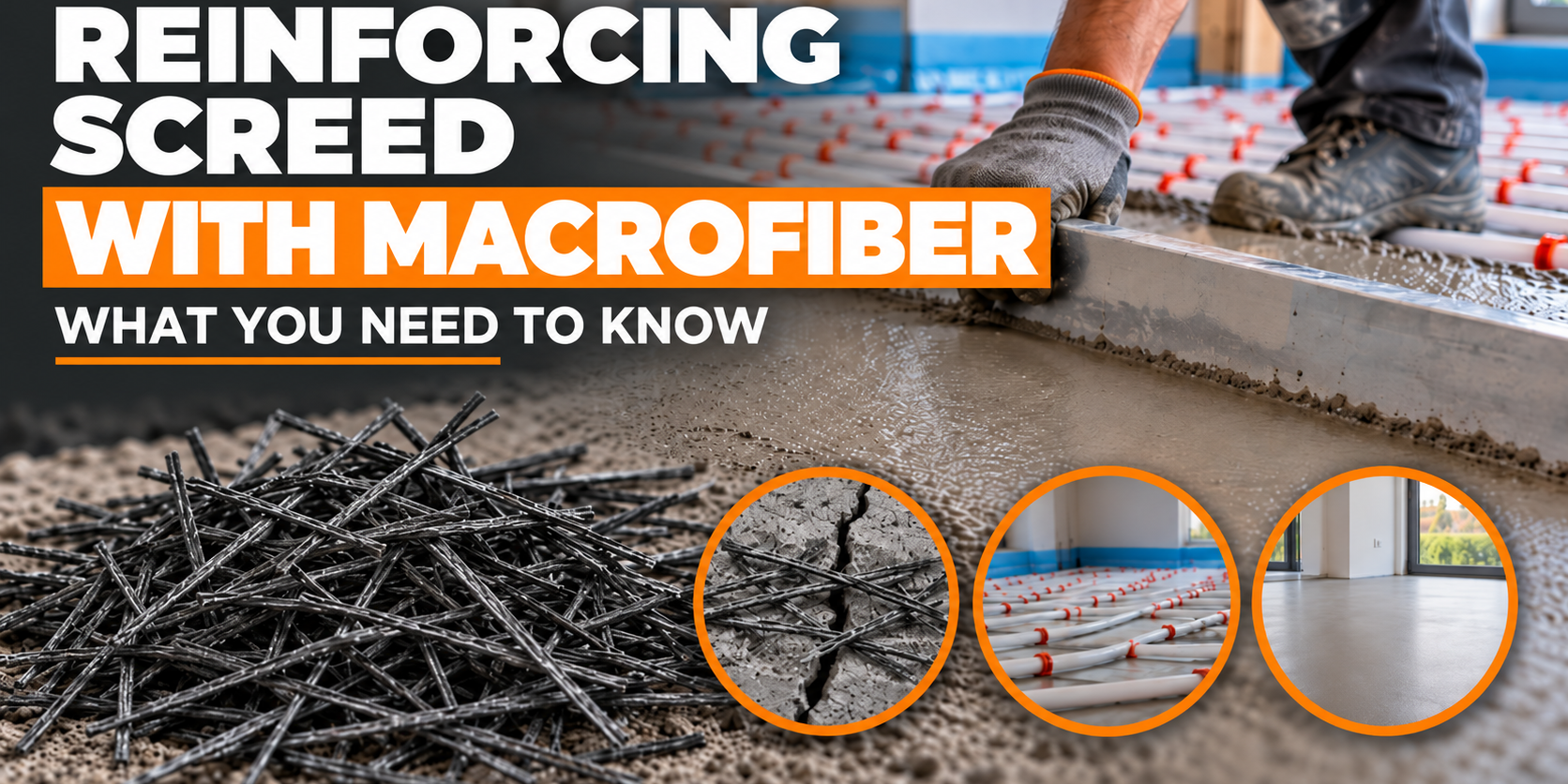
Macrofibres are longer, comparatively strong fibres, often made of polypropylene or other plastics. When mixed in, they are distributed evenly throughout the fresh screed. Unlike a steel mesh, they are not confined to a specific depth but are present throughout the entire material.
If a crack develops later, fibres that cross this crack can transfer tensile forces between the two sides of the crack. This property is known as post-crack behaviour: what matters is not only when the first crack develops, but also how the layer behaves under load afterwards.
Whether this effect actually occurs on the required scale depends on the specific product, the dosage and the screed mix. A macrofibre does not turn an unsuitable screed into a suitable one – nor does it replace sufficient thickness or professional installation.
Microfibre or macrofibre: what’s the difference?
The two types of fibre are often confused, even though they serve different purposes.
Microfibres are very fine. They are primarily used to reduce the risk of fine early-stage shrinkage cracks in the material whilst it is still young. One must not assume that they provide any load-bearing capacity once larger cracks have formed.
Structural macrofibres are significantly stronger. Suitable products can transfer forces across existing cracks. Polymer macrofibres are classified as Class II according to DIN EN 14889-2. However, for a reinforcing function, the declared and tested properties of the specific product are decisive – the designation ‘macrofibre’ alone is not sufficient.
If you want to replace steel mesh, it is therefore not enough simply to add any old fibre to the mixer. Check whether the fibre is intended for this purpose and whether its performance is documented in a verifiable manner.
Can macrofibre replace the steel mesh in screed?
Yes, in appropriate cases – but the first question must be whether a steel mesh is required at all. For floating screeds laid on insulation layers, reinforcement in accordance with DIN 18560-2 is not generally required. In such cases, therefore, a steel mesh is not automatically necessary and can be omitted.
The situation is different if additional reinforcement has been planned for a specific structure, for example to limit crack width or due to particular stresses. In such cases, a suitable macro-fibre solution may be an option. However, an equivalent substitute must be assessed on the basis of the required function and the technical evidence. After all, steel mesh and macrofibres do not act in the same way.
Particularly important: A mat can also be used to secure heating pipes. If it is not used, the pipes must be secured by a heating system designed for this purpose. The fibres do not hold heating pipes in place.
For which types of screed are macrofibres a good choice?
Whether a macro-fibre is suitable depends on the overall soil structure.
Bonded screed: It is firmly bonded to the load-bearing sub-base. In suitable cement-bound mixtures, macrofibres can fulfil an additional function. However, this cannot compensate for poor bonding to the sub-base.
Screed on a separating layer: It rests on a separating layer and can move relative to the sub-base. The design must take into account the layer thickness, load, joints and the suitability of the fibres.
Floating screed: This is laid on top of thermal or impact sound insulation. In this case, the compressive strength and compressibility of the insulation, the flexural tensile strength of the screed and its thickness are particularly important. The use of macrofibres does not mean that the layer can be made as thin as one wishes.
Heated screed: A suitable fibre can also be used with underfloor heating. However, it must be compatible with the mix, provide adequate pipe coverage and comply with the heating protocol.
In the case of calcium sulphate self-levelling screeds, specialised rapid-setting and thin-layer screeds, or ready-mixed bagged compounds, you should only add fibres with the express approval of the relevant system manufacturer. Making changes to the formulation without authorisation may alter the guaranteed properties.
Macrofibre in screed with underfloor heating
There is a great deal of interest in straightforward reinforcement, particularly when it comes to underfloor heating. After all, heating pipes, brackets, insulation and screed are all laid on top of one another in a confined space. An additional steel mesh can make installation more labour-intensive.
Macrofibres are mixed directly into the screed. In suitable structures, this means that a reinforcement mesh laid separately is no longer required. However, this does not mean that the fibres prevent thermal movement or rule out all stress cracks.
There are three key points to bear in mind with heated screeds: Firstly, the heating pipes must be securely fixed and completely encased by the intended screed. Secondly, the required layer thicknesses and pipe coverings for the specific installation must be observed. Thirdly, edge strips and movement joints must be planned correctly, particularly at doorways and between areas with different heating systems.
The initial heating-up process must not be started at random either. With conventional cement-based underfloor heating screeds, functional heating usually takes place no earlier than 21 days after installation; with calcium sulphate screeds, it is often no earlier than seven days. Any differing specifications for specific systems take precedence. Furthermore, functional heating does not replace the need to verify that the screed is ready for flooring before laying the floor covering.
What are the benefits of screed containing macrofibres?
The practical benefits lie primarily in the processing and – provided the relevant performance data is available – in the behaviour of the material following crack formation.
- Easier to use: The fibres can be mixed into the screed mortar. There is no need to cut, transport or position an additional steel mesh, provided that it is not technically required.
- Distribution within the material: When mixed correctly, the fibres are distributed throughout the entire cross-section, not just in a single plane.
- No rusting of the plastic fibres: polypropylene does not corrode in the same way as steel. This is particularly beneficial in damp environments.
- Fewer steps: For suitable projects, omitting a planned mat saves time and space on site.
- Improved crack propagation behaviour: Suitable structural fibres, used in sufficient quantities, can transfer forces after a crack has formed.
Not every benefit is present in every screed mix. What counts for the assessment are the technical properties of the finished screed, not just the benefits of the fibre listed on the data sheet.
How much macro-fibre is needed per cubic metre of screed?
There is no single figure that can be used to determine the correct dosage across the board. The relevant factors are the type of fibre, its length, the screed thickness, the mix, the load and the intended function.
ArmoTec specifies approximately 3 kg/m³ of Beton Booster for standard screed concrete as a general guide. This is not automatically a valid design value for every floating screed, every thin layer or every underfloor heating system. Before use, it must be clarified whether the product is compatible with the specific mix and the intended layer thickness.
Here is an example to illustrate how to calculate the quantity: An area of 80 m² with a screed thickness of 6 cm results in 80 × 0.06 = 4.8 m³ of screed. If 3 kg/m³ has been specified and approved for this exact construction, this amounts to 14.4 kg of macrofibre.
The calculation is simple. The technical decision lies in choosing the correct dosage. Too little fibre may fail to achieve the desired effect; too much fibre, or fibre mixed in incorrectly, can make the work more difficult. The fibre length must also be suited to the thickness and consistency of the screed.
Laying a screed with macro-fibres: step by step
1. Determine the floor structure. Establish whether a composite screed, a screed on a separating layer or a floating screed is to be used. Determine the loads, the screed strength, the thickness and, where applicable, the underfloor heating system.
2. Check the suitability of the fibres. Compare the technical data sheet, declaration of performance and manufacturer’s specifications with the intended screed mortar. For system screeds and special constructions, explicit approval is essential.
3. Prepare the substrate. Composite surfaces must be sufficiently load-bearing and properly prepared. In the case of floating screeds, the insulation, covering and perimeter insulation strips must be installed without gaps and in accordance with best practice.
4. Plan for expansion joints and heating pipes. Determine the location of expansion joints before installation. Heating pipes must be securely fixed and protected from damage. Existing structural joints must not simply be covered over.
5. Measure out and mix the fibres correctly. Add the specified amount in accordance with the manufacturer’s instructions. Mix for long enough to ensure the fibres are evenly distributed. Avoid lumps of fibres and do not attempt to correct a mixture that is too stiff by adding extra water on your own initiative.
6. Lay the screed correctly. Ensure that the planned thickness, compaction and levelness are achieved. The surface is then finished to suit the subsequent floor covering. Depending on the product and surface treatment, fibre ends may occasionally be visible.
7. Carry out post-treatment and check that the floor is ready for covering. Protect fresh cement screed from drying out too quickly and from unfavourable temperatures. Observe the specified waiting times. For heated screeds, the heating log and moisture test are particularly important.
What mistakes should you definitely avoid?
Macrofibres are no substitute for the fundamentals of a good screed. Common mistakes include applying the layer too thinly, using unsuitable insulation, failing to include movement joints, inadequate compaction and allowing the screed to dry out too quickly.
It is equally problematic to reduce the dosage without verification, to mix in fibres unevenly, or to alter the formulation of a ready-mixed screed system without authorisation. In the case of thin layers, the fibre length can be particularly critical.
You should also avoid a common misconception: a robust concrete workshop floor and a floating screed in a living area serve different purposes. The recommended amount of fibre for a 10-centimetre-thick concrete slab cannot automatically be applied to every 5-centimetre-thick heated screed.
Is macrofibre cheaper than steel mesh?
That depends on what is actually specified in the original design. If no steel mesh is required at all, its supposed ‘replacement’ will not result in any real savings. The macrofibre would then be an additional material item, the benefits of which would need to be justified.
If, on the other hand, steel mesh reinforcement has been professionally designed and it can be demonstrably replaced by fibres, the costs of the mesh, transport, cutting to size, spacers and installation can be eliminated. On the other hand, there is the cost of the fibres, as well as any additional costs for mixing and quality assurance.
You should therefore always compare the total costs of two technically equivalent solutions. Simply comparing prices per kilo is misleading.
What standards are important for fibre-reinforced screed?
In Germany, the following sets of regulations are particularly important:
- DIN 18560: Requirements for the design and construction of various screed systems. Part 2 covers floating screeds and heated screeds laid on insulation layers.
- DIN EN 13813: Requirements and performance classes for screed mortars and screed compounds, such as compressive strength and flexural tensile strength.
- DIN EN 14889-2: Product standard for polymer fibres, including Class II macrofibres.
- DIN EN 1264-4: Specifications relating to water-based surface heating and cooling systems and their commissioning.
Compliance with a fibre standard does not automatically mean that any load-bearing reinforcement may be replaced. In the case of special loads or non-standard designs, due regard must be paid to the design, the necessary structural analyses and, where applicable, building regulations.
Frequently asked questions about screed with macrofibre
Can I lay a screed without using any steel mesh at all?
Yes. Many standard floating screeds are laid without steel mesh. Whether additional fibres are advisable depends on the specific construction and the desired properties. Existing steel mesh may only be omitted if its intended function is fulfilled by other means.
Do macrofibres completely prevent cracks in the screed?
No. Cracks can also form with macro-fibres. Suitable fibres can influence their development and transfer forces once a crack has formed. Incorrect joint design, drying too quickly or an unsuitable substrate remain possible causes of damage.
Are macrofibres suitable for underfloor heating?
In principle, yes, provided suitable cement-bound systems are used. It is important to ensure that the system is approved for the specific screed, that the pipes are securely fixed, that the required pipe cover depth is maintained, and that the correct heating procedure is followed. The macrofibres do not replace the jointing plan.
Can I reduce the thickness of the screed by using microfibre?
Not without evidence. The required layer thickness is determined by the design, load, strength class and, where applicable, heating pipes. Any reduction in thickness must be technically justified and permitted for the system in question.
Which is better: steel mesh or macrofibre?
There is no one-size-fits-all answer to this. Often, with a standard floating screed, neither is required. If reinforcement is to be used, the choice depends on its intended function, the available structural analysis and cost-effectiveness. Macrofibres are not a universal substitute for steel.
Conclusion: Use macrofibres sensibly rather than reinforcing blindly
Reinforcing a screed with macrofibres can simplify the installation process and, with appropriate planning, offer technical advantages. However, the key is not to incorporate as much reinforcement material as possible, but to choose the correct floor structure. Reinforcement is generally not required for floating screeds. Where special requirements apply, however, suitable macro-fibres can offer an interesting solution.
Are you planning a cement-bound screed and want to check whether ArmoTec is suitable for your project? Find out more about ArmoTec structural macro-fibre and use the Concrete Booster Calculator to get an initial idea of the quantities required. For screed constructions that differ from the standard, suitability should be assessed by a specialist prior to installation.