

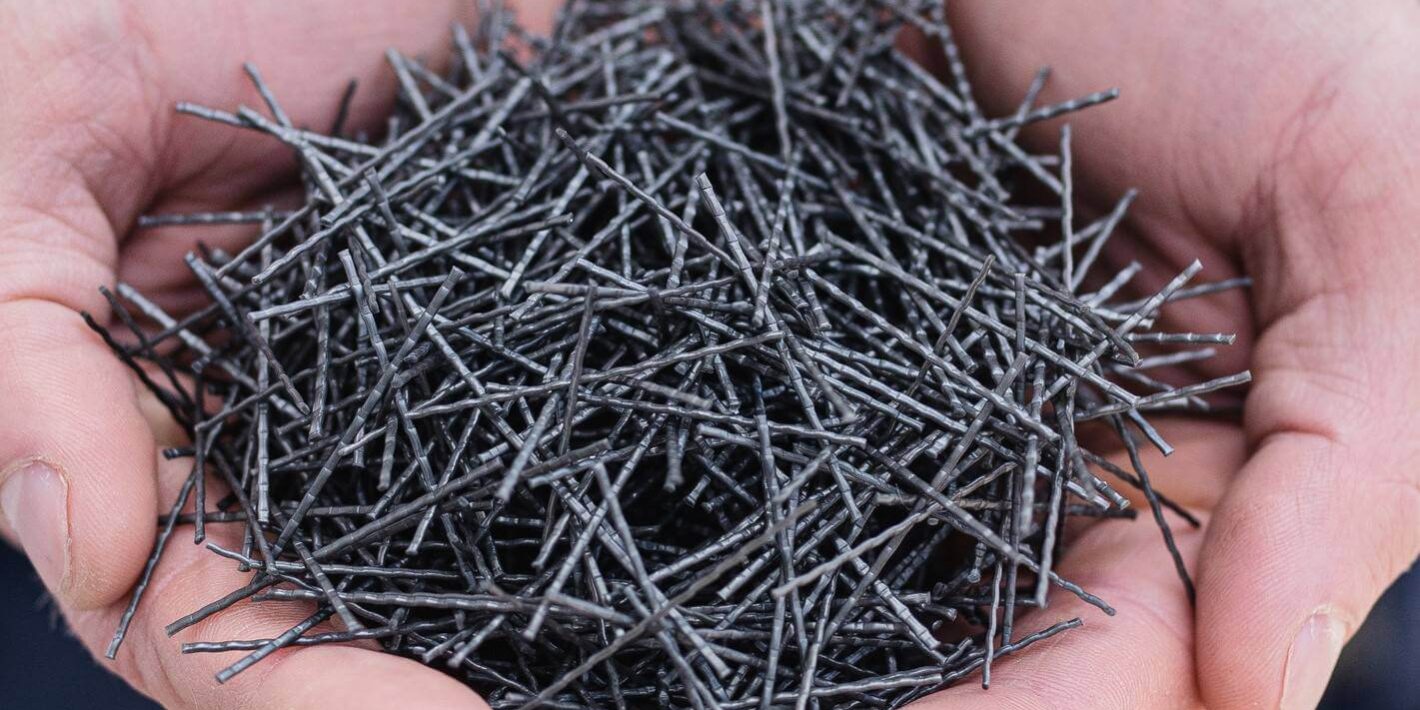
How They Work, Where They Are Used and Their Benefits in Concrete
Concrete withstands compressive loads extremely well, but it is much more sensitive to tensile and bending stresses. Internal stresses can develop as early as the setting and drying stages. Later, temperature changes, movement of the sub-base, vehicles and other loads place further stress on the concrete.
For this reason, most concrete structures require some form of reinforcement.
For a long time, reinforcing bars and welded steel mesh were almost the only solutions considered. Today, however, other methods are also available. One of these is structural macrofibre reinforcement, which is mixed directly into the fresh concrete.
But what exactly is a macrofibre, how does it work, and can it really replace steel reinforcement mesh?
What is a macrofibre?
A macrofibre is a high-strength fibre specifically manufactured to reinforce concrete. It is usually made from a synthetic material such as polypropylene.
At first glance, it may look like a simple piece of plastic. In reality, however, a high-quality structural macrofibre:
- has a defined tensile strength;
- has a shape and surface designed to bond effectively with concrete;
- is resistant to the alkaline environment of concrete;
- is capable of bridging cracks that develop in the concrete;
- has verified performance and the necessary construction documentation.
Its purpose is not simply to ensure that “there is something in the concrete”. When correctly dosed, the macrofibres continue to work after the concrete has hardened, helping to limit crack opening and distribute loads.
This is why they are also referred to as structural macrofibres.
How do macrofibres work in concrete?
Macrofibres are added to the fresh concrete and mixed for the required amount of time. During mixing, the fibres are distributed throughout the entire volume of the concrete.
This is an important difference compared with traditional steel reinforcement mesh.
Steel mesh is positioned in a single, defined plane. It works correctly only if it is placed at exactly the designed height within the concrete cross-section. If it remains on the ground or on top of the insulation during construction, it cannot perform its intended function properly.
Macrofibres, on the other hand, are not arranged in a single layer. They are distributed throughout the entire concrete mass, creating three-dimensional reinforcement.
When a crack begins to form, the fibres crossing its path connect the two sides of the crack. They can be imagined as thousands of tiny bridges spanning the developing crack.
The fibres can:
- slow down crack opening;
- limit crack width;
- help transfer loads;
- improve the post-cracking load-bearing capacity of the concrete;
- reduce the risk of sudden failure.
It is important to be precise: macrofibres cannot make concrete completely crack-free. Crack formation is affected by many other factors, including the concrete mix, the amount of water, the load-bearing capacity of the sub-base, slab thickness, expansion and contraction joints, and curing.
Macrofibre reinforcement is an important part of a properly constructed concrete slab, but it is not a miracle solution that overrides all other construction requirements.
What is the difference between microfibres and macrofibres?
Microfibres and macrofibres are often confused, even though they serve different purposes.
| Criteria | Microfibre | Structural macrofibre |
|---|---|---|
| Size | Shorter and thinner | Longer and thicker |
| Primary purpose | Reducing early shrinkage cracks | Bridging cracks and distributing loads |
| Period of effectiveness | Primarily during the early stages of setting | Also works in hardened concrete |
| Structural role | Usually none | Possible based on verified performance and structural calculations |
| Replacement of steel mesh | Not suitable | May be suitable in certain concrete slabs |
| Typical dosage | Small quantity | Higher dosage adapted to the expected loads |
Microfibres act like a dense network of fine threads within the fresh concrete. They are primarily effective while the concrete is still setting and losing moisture. They can help reduce fine cracks caused by early plastic shrinkage.
Structural macrofibres are thicker, longer and capable of carrying significantly greater forces. They continue to work in hardened concrete when the structure is subjected to loads or when a crack begins to open.
For this reason, conventional thin microfibres must not be used to replace steel reinforcement mesh.
Macrofibres or steel reinforcement mesh?
Steel reinforcement mesh and structural macrofibres reinforce concrete in two different ways.
Steel mesh is positioned in a defined plane. It must be properly supported, the sheets must overlap, and care must be taken during concreting to ensure that the mesh does not move.
In practice, this is not always achieved. Particularly on smaller projects, the mesh is often simply placed on the ground or insulation before the concrete is poured over it. It then remains near the bottom of the slab and cannot work where it is actually needed.
Macrofibres are distributed throughout the entire volume of the concrete. They do not require cutting, overlapping, tying or the use of spacers. They cannot be pushed down to the ground during concreting, and they do not rust.
However, this does not mean that macrofibres can replace steel reinforcement in every structure.
Steel may have a primary load-bearing role in structures such as suspended slabs, beams or columns. In these cases, it must not be replaced with macrofibres without proper structural design. If a building component has been designed as reinforced concrete, it must be constructed using the specified steel reinforcement.
Structural macrofibres primarily offer a simpler solution for ground-supported concrete slabs in which the main purpose of the steel mesh is to limit cracking and distribute loads.
Where can structural macrofibres be used?
Macrofibres are most commonly used in ground-supported, slab-like concrete structures.
Typical applications include:
- driveways;
- garage floors;
- pavements and walkways;
- terraces;
- concrete yards;
- residential floor screeds;
- screeds with underfloor heating;
- blinding concrete;
- workshop and warehouse floors;
- agricultural concrete yards;
- livestock building floors;
- industrial floors;
- certain foundation slabs when supported by appropriate structural calculations.
In these structures, the concrete is largely supported by a properly compacted sub-base beneath it. The main purpose of the reinforcement is generally not to carry the full load of a freely spanning structure, but to help distribute loads and limit crack opening.
However, suitability must always be assessed for the individual structure. There is an enormous difference between a walkway around a family home and a heavily trafficked industrial floor, even though both are ground-supported concrete slabs.
Where are macrofibres alone not sufficient?
One of the most important limitations of macrofibre reinforcement is that it cannot replace steel reinforcement completely in every concrete structure.
It is generally not recommended as the sole reinforcement in:
- suspended slabs;
- beams;
- columns;
- lintels;
- retaining walls;
- balcony slabs;
- staircases;
- suspended or freely spanning structures;
- foundations subjected to major structural loads.
In these structures, steel reinforcement often performs a primary load-bearing function. A structural engineer must determine the required reinforcement and whether macrofibres may be used as an additional form of reinforcement.
A simple rule can help: if the concrete is not supported by the ground, but instead spans, hangs or forms an important part of the building’s load-bearing structure, macrofibres must not automatically be chosen instead of steel reinforcement.
What are the benefits of macrofibres?
One of the greatest advantages of macrofibres is simpler construction.
Steel reinforcement mesh must be transported to the site, cut to size, overlapped, tied together and placed on spacers. This requires time, labour and appropriate expertise.
Macrofibres take up little space during transport and can be added directly to the concrete.
Additional benefits include:
- distribution throughout the entire concrete volume;
- no corrosion;
- no cutting or tying;
- no need to move heavy steel mesh;
- faster preparation;
- reduced labour requirements;
- no risk of being placed at the wrong height during concreting;
- even reinforcement in complex-shaped concrete areas;
- potentially lower total costs on certain projects.
Costs should not be compared solely on the basis of the purchase price of steel mesh and macrofibres. Transport, unloading, cutting waste, spacers, tying and labour costs must also be taken into account.
How should macrofibres be added to concrete?
Macrofibres can be added at the batching plant or during on-site concrete mixing. The most important requirement is to distribute the fibres evenly throughout the concrete.
The manufacturer’s instructions must always be followed. The fibres should not be added to the mixer as one large, compact bundle. Gradual addition and an adequate mixing time can reduce the risk of fibre balling.
After adding the fibres, the concrete must be mixed until they are distributed evenly.
The use of macrofibres does not replace:
- the correct concrete grade;
- proper compaction of the sub-base;
- the required slab thickness;
- correct concrete placement;
- proper compaction of the concrete;
- correctly designed expansion and contraction joints;
- curing that begins at the appropriate time.
If, for example, a concrete slab is constructed on a weak and unstable sub-base, neither steel mesh nor macrofibres alone can fully protect it from damage.
How much macrofibre is required per cubic metre of concrete?
The correct dosage cannot be determined using a single figure that applies to every concrete project.
The required amount depends on:
- slab thickness;
- concrete quality;
- the load-bearing capacity of the sub-base;
- the expected load;
- the frequency of loading;
- the size of the joint fields;
- the verified performance of the fibre;
- the intended use of the structure.
A pedestrian walkway and an industrial floor exposed to lorries cannot automatically be constructed using the same fibre dosage.
For ArmoTec structural macrofibres, the typical dosages for an average 10-centimetre-thick concrete slab may fall within the following ranges:
| Application | Indicative ArmoTec dosage |
|---|---|
| Walkway or residential floor screed | approximately 2.5 kg/m³ |
| Average ground-supported concrete slab | approximately 3 kg/m³ |
| Garage or passenger car driveway | approximately 4 kg/m³ |
| Structure exposed to higher loads | approximately 5–6 kg/m³ or according to structural calculations |
These figures are for guidance only and do not replace an assessment of the individual structure. Structural calculations may be required for heavily loaded, unusual or load-bearing structures.
The claim that one kilogram of fibre per cubic metre is sufficient for every concrete project is misleading. The dosage must always be determined according to the product’s verified performance and the expected loads on the concrete slab.
What documentation should a structural macrofibre have?
Structural macrofibres are incorporated into building structures. It is therefore not enough to know that a product is made of plastic, appears strong and can be mixed into concrete.
For a reliable product, the following should be checked:
- compliance with the applicable standard;
- CE marking;
- Declaration of Performance;
- clear identification of the manufacturer and product;
- recommended dosage range;
- test results;
- values demonstrating residual flexural tensile strength.
An important European standard for polymer fibres used in concrete is EN 14889-2. However, compliance with the standard alone does not mean that every product has the same performance.
Concrete tests, including the CMOD test, help demonstrate these differences. CMOD stands for Crack Mouth Opening Displacement. The test shows how fibre-reinforced concrete behaves after a crack has formed and how much load it can still carry.
The more important the intended role of the fibre, the more essential it is to assess not only its shape or tensile strength, but also the verified performance of the finished fibre-reinforced concrete.
Common misconceptions about macrofibres
“All plastic fibres are the same”
This is not true. Fibres can differ significantly in material, length, thickness, shape, surface and tensile strength. Two products that look similar may perform very differently when tested in concrete.
“One kilogram is enough for every concrete project”
There is no universal dosage suitable for every structure. The amount of fibre per cubic metre must be adapted to the expected loads and the product’s verified performance.
“Expansion and contraction joints are unnecessary when macrofibres are used”
Macrofibres do not eliminate the need for joints. Stresses caused by shrinkage and thermal movement must still be managed.
“Macrofibres can replace steel reinforcement everywhere”
This is not true. They can primarily replace steel mesh with a secondary reinforcement role in ground-supported concrete slabs. Suspended slabs, beams, columns and other load-bearing structures require structural design.
“Curing can be omitted when fibres are used”
Curing remains essential even when macrofibres are used. If the surface of the fresh concrete dries too quickly, cracks may develop.
“The more fibres added to the concrete, the better”
Excessive dosage can make mixing, placing and finishing more difficult. The aim is not to use as much fibre as possible, but to apply the required and verified quantity.
What should you consider when choosing a macrofibre?
The price alone does not determine whether a fibre is suitable for a particular concrete project.
Before making a decision, it is worth checking:
- the standards and documentation supplied with the product;
- whether verified concrete test results are available;
- the applications recommended by the manufacturer;
- the required dosage;
- the residual strength values it provides;
- whether it can be mixed and distributed easily;
- whether technical support is available;
- whether there is practical experience from real projects;
- whether structural calculations can be provided when necessary.
Instead of comparing only the price per kilogram, compare the total cost required to reinforce one cubic metre of concrete. A cheaper fibre is not necessarily a more economical solution if a significantly larger quantity is required to achieve the same performance.
Summary
Structural macrofibres provide a modern method of reinforcing concrete in three dimensions. They are added directly to fresh concrete and distributed throughout the entire concrete mass during mixing.
By bridging developing cracks, the fibres help limit crack opening and distribute the loads acting on the concrete slab.
Their most important areas of application are ground-supported, slab-like concrete structures, including:
- driveways;
- garage floors;
- walkways;
- terraces;
- residential floor screeds;
- workshop and industrial floors;
- agricultural concrete yards.
With the correct product, properly determined dosage and professional construction, macrofibres can replace steel reinforcement mesh that performs a secondary role in certain applications.
However, they cannot replace steel in every structure. If the concrete spans, is suspended or performs a primary load-bearing role, the required reinforcement must be determined by a structural engineer.
Frequently asked questions
Can macrofibres replace steel reinforcement mesh?
Yes, in certain ground-supported concrete slabs where the steel mesh serves a secondary reinforcement function. However, it must not be replaced without proper design in load-bearing reinforced concrete structures.
Can macrofibres be used in a driveway?
Yes. A ground-supported driveway exposed to passenger cars is a typical application for structural macrofibres. The appropriate dosage must be determined according to the slab thickness, concrete quality and expected loads.
Are joints required in fibre-reinforced concrete?
Yes. Macrofibres do not replace correctly designed expansion and contraction joints.
Do polymer macrofibres rust?
No. Polypropylene macrofibres do not corrode like steel.
Will macrofibres remain visible on the concrete surface?
A few fibres may appear on the surface of freshly placed concrete. With proper finishing, most of them can be worked into the surface. Any exposed fibre ends may also wear away mechanically over time.
How much macrofibre is required per cubic metre of concrete?
The required amount depends on the product, slab thickness and expected loads. For ArmoTec, typical dosages in ground-supported concrete slabs range from approximately 2.5 to 6 kg/m³.
Not sure how much macrofibre your concrete project requires? Use our calculator to find out how much structural macrofibre you need and how much you can save compared with steel reinforcement mesh.