
Why Does Concrete Need Reinforcement?
Concrete can withstand extremely high compressive loads, which makes it an excellent material for foundations, floors, roads and various load-bearing structures. However, it is far more vulnerable under tensile and bending loads, which can cause it to crack more easily.
This means that while concrete can support considerable weight from above, stresses coming from below or from the side may already cause cracks.
It is important to understand that these stresses are not only caused by heavy loads. Concrete:
- shrinks during setting and drying,
- expands and contracts as temperatures change,
- reacts to movement in the subgrade,
- and is also affected by vehicle traffic and concentrated loads.
What Does Reinforcement Do?
Concrete reinforcement has several important functions:
- it limits the formation and width of cracks,
- it bridges cracks that have already formed,
- it distributes loads more evenly,
- it increases resistance to bending and impact,
- and it reduces the risk of minor cracks developing into serious structural damage.
It is important to note that reinforcement does not mean concrete will never crack. The goal is to keep cracks under control and ensure the structure remains safe and usable over the long term.
Is It Possible to Reinforce Concrete Without Steel?
The answer is yes, in certain cases, but not in every type of structure.
Whether steel reinforcement can be omitted always depends on:
- the type of structure being built,
- the loads it will carry,
- the thickness of the concrete,
- and the conditions in which it will be used.
Where Does Steel-Free Reinforcement Work Well?
Fibre-reinforced concrete is increasingly used in:
- ground-supported concrete slabs,
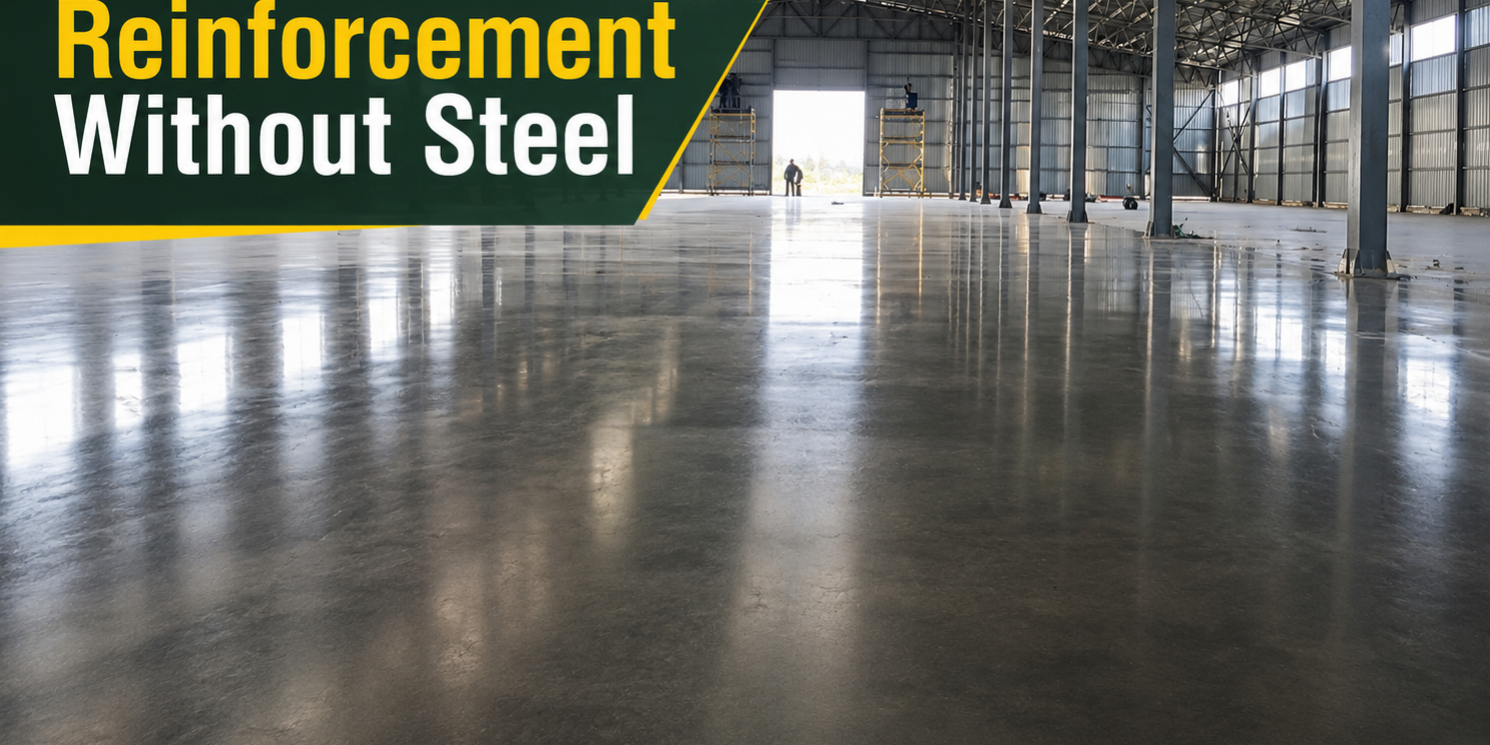
- industrial floors,
- outdoor concrete areas,
- driveways,
- agricultural concrete surfaces.
In these applications, the reinforcing fibres are added to the concrete during mixing, allowing them to become distributed throughout the entire concrete volume.
What Must Be Considered?
One of the most important principles is:
The selected reinforcement must genuinely be capable of performing the required structural function.
A microfibre, for example, can help reduce early shrinkage cracks in fresh concrete, but it does not replace structural reinforcement.
For this purpose, a structural macrofibre is required. When correctly selected and dosed, it can:
- bridge cracks,
- transfer forces across cracks,
- and distribute loads within the concrete slab.
When Can Steel Not Be Omitted?
Steel reinforcement may still be essential in structures such as:
- suspended slabs,
- beams,
- columns,
- heavily loaded or strongly bending structural elements.
In these cases, the reinforcement system must always be determined by a qualified structural engineer.
The real question is therefore not whether steel can always be omitted, but which reinforcement solution can safely perform the required task in the specific structure.
What Exactly Does Concrete Reinforcement Without Steel Mean?
Steel-free concrete reinforcement does not mean leaving the concrete unreinforced. The concrete still contains a material or structural component that:
- controls cracks,
- distributes loads,
- and improves durability.
The difference is that these tasks are not performed by traditional reinforcing bars or welded steel mesh.
The Most Common Solution: Fibre-Reinforced Concrete
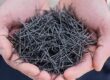
With this method, different types of fibres are mixed directly into the concrete. These fibres:
- become distributed throughout the concrete volume,
- and are not positioned in only one plane, as steel mesh normally is.
Common Types of Steel-Free Reinforcement
- microfibres,
- structural macrofibres,
- glass-fibre reinforcement,
- basalt-fibre reinforcement,
- fibre-reinforced composite bars and meshes.
What Is the Difference Between Them?
Microfibres are mainly used to reduce early-age shrinkage cracking in fresh concrete.
Structural macrofibres are larger, stronger fibres that can also perform a structural reinforcing function when they are properly designed and dosed.
Why Is Steel-Free Reinforcement Beneficial?
Its main advantages include:
- three-dimensional reinforcement,
- no risk of corrosion,
- and simpler construction.
How Do Structural Macrofibres Work in Concrete?
Structural macrofibres are added directly to fresh concrete. During proper mixing, the fibres are distributed throughout the entire concrete volume, creating three-dimensional reinforcement.
This is significantly different from welded steel mesh. Steel mesh is positioned at a specific height and in a single plane. Macrofibres, in contrast, are present throughout the entire cross-section of the concrete.
What Happens When a Crack Forms?
Small cracks may begin to form in concrete as a result of loading, shrinkage or temperature changes. When a crack reaches the fibres, the fibres connect the two sides of the crack and continue transferring forces between them.
This is known as crack bridging.
The fibres therefore:
- slow down crack opening,
- limit crack width,
- help transfer loads,
- and allow the concrete to retain part of its load-bearing capacity after cracking.
The Material of the Fibre Is Not the Only Important Factor
Several properties must work together for the fibre to perform correctly:
- suitable fibre length,
- sufficient tensile strength,
- reliable bonding with the concrete,
- suitable surface design,
- sufficient fibre dosage,
- even distribution throughout the concrete.
A smooth, weak or excessively short plastic fibre cannot perform the same task as a structural macrofibre specifically developed for concrete reinforcement.
What Are the Advantages of Concrete Reinforcement Without Steel?
The benefits of steel-free reinforcement cannot be assessed simply by comparing the purchase price of fibres with the price of welded steel mesh. The complete construction process must be considered.
Simpler Construction
Steel mesh must be transported to the construction site, unloaded, cut to size, overlapped, tied together and placed on suitable spacers.
When structural macrofibres are used, many of these work stages can be eliminated. The fibres are dosed into the concrete and mixed thoroughly.
This can provide a major advantage when concreting large areas.
Shorter Preparation Time
Installing steel mesh can require significant time and labour. Fibre reinforcement can reduce preparation time because separate reinforcement installation is no longer required.
Faster construction can:
- reduce labour costs,
- shorten the construction schedule,
- and simplify site organisation.
Less Material Handling
Steel mesh is heavy, requires a large storage area and often needs several workers or machinery for handling.
Structural macrofibres are lightweight, easy to store and simpler to transport to the construction area. This is especially beneficial on smaller sites or in locations that are difficult to access.
No Risk of Corrosion
Steel can corrode in the presence of moisture and oxygen. If concrete cracks or the concrete cover around the reinforcement is insufficient, corrosion may gradually damage the structure.
Polymer structural macrofibres do not rust. This can make them particularly advantageous in:
- wet environments,
- agricultural buildings,
- outdoor concrete surfaces,
- floors exposed to chemical substances,
- and areas exposed to regular water contact.
No Sunken or Incorrectly Positioned Mesh
Steel mesh works properly only if it remains in its designed position. In practice, mesh may be laid directly on the subgrade, moved during concreting or pushed down when workers step on it.
In these cases, the reinforcement is no longer positioned at the correct height to perform its intended structural function.
Properly mixed macrofibres, however, are distributed throughout the concrete volume. There is therefore no risk of the reinforcement being positioned too low or too high in a single plane.
In Which Applications Can Steel Reinforcement Be Replaced?
Structural macrofibres can primarily replace traditional welded steel mesh in ground-supported concrete slabs built on a properly prepared and compacted subgrade.
Possible applications include:
- industrial floors,
- warehouse floors,
- workshop floors,
- agricultural concrete yards,
- livestock building floors,
- machinery shed floors,
- garage floors,
- driveways,
- outdoor concrete surfaces,
- pavements,
- terraces,
- lightly loaded ground-supported slabs,
- certain slab foundations.
However, this list does not mean that every such structure can automatically be built without steel reinforcement.
What Determines Whether Steel Can Be Replaced?
The following factors must be considered:
- the intended load,
- slab thickness,
- concrete strength class,
- the bearing capacity of the subgrade,
- the compaction of the base layer,
- the size of the joint panels,
- concentrated loads,
- vehicle and machinery axle loads,
- the properties of the macrofibre,
- and the required fibre dosage.
A driveway used by passenger cars and an industrial floor exposed to heavy forklifts are subject to entirely different loads. Therefore, the same concrete thickness and fibre dosage cannot be used for both.
When Should Steel Reinforcement Not Be Automatically Omitted?
Structural macrofibres are not a universal replacement for steel in every reinforced-concrete structure.
Particular care is required in elements that span freely, are exposed to significant bending loads or play a critical role in supporting the building.
Examples include:
- suspended slabs,
- beams,
- columns,
- lintels,
- balcony slabs,
- retaining walls,
- cantilever structures,
- long-span structural elements,
- heavily loaded foundation structures.
In these structures, the amount, position and arrangement of steel reinforcement are determined through structural calculations. Macrofibres may sometimes be used as supplementary reinforcement, but steel may only be removed if the structural designer approves the solution.
Even a Ground-Supported Slab Is Not Always Simple
A ground-supported slab may still require local steel reinforcement:
- beneath walls,
- around columns,
- near door and gate openings,
- around pits and penetrations,
- at structural connections,
- at locations exposed to heavy concentrated loads.
In these situations, fibre reinforcement and local steel reinforcement can also be used together.
Welded Steel Mesh or Structural Macrofibre?
Both welded steel mesh and structural macrofibres can reinforce concrete, but they work in different ways.
| Aspect | Welded steel mesh | Structural macrofibre |
|---|---|---|
| Position | In one defined plane | Throughout the concrete volume |
| Installation | Requires separate installation | Mixed directly into fresh concrete |
| Transport | Heavy and requires considerable space | Lightweight and easy to store |
| Corrosion | May corrode under certain conditions | Does not rust |
| Spacers | Usually required | Not required |
| Cutting and overlapping | May be necessary | Not necessary |
| Risk of incorrect placement | Mesh may move or sink | Fibres are distributed through proper mixing |
| Construction time | May require longer preparation | Can shorten preparation time |
| Design method | Based on steel quantity and arrangement | Based on fibre performance and dosage |
Which Solution Is Better?
There is no single answer that applies to every structure.
Steel reinforcement is an established and reliable solution for many load-bearing structures. Structural macrofibres, however, can provide important advantages in ground-supported slabs by making construction simpler, faster and more economical.
The correct solution should not be chosen on the basis of habit. It must be determined by the function of the structure, the expected loads and the engineering design.
How Is the Required Fibre Dosage Determined?
Structural macrofibre dosage cannot be determined solely from the volume of concrete without understanding the application conditions.
The appropriate dosage is influenced by:
- slab thickness,
- concrete strength,
- subgrade bearing capacity,
- slab area,
- joint layout,
- expected loads,
- vehicle weight,
- axle loads,
- concentrated loads,
- and the technical performance of the fibre.
Why Does the Type of Macrofibre Matter?
Products from different manufacturers may vary in:
- tensile strength,
- flexibility,
- fibre length,
- surface profile,
- bonding performance,
- and residual load-bearing capacity after cracking.
For this reason, using the same dosage in kilograms for two different macrofibres does not necessarily provide the same structural performance.
The required dosage must therefore be determined according to the technical properties of the specific product and the loads acting on the slab.
Is a Structural Calculation Necessary?
For smaller residential projects exposed to light loads, it may be sufficient to follow the manufacturer’s application and dosage recommendations.
Examples include:
- a small pavement,
- a terrace,
- a garden concrete area,
- a lightly used outdoor slab.
For higher loads or larger investments, however, structural design is recommended.
When Is a Calculation Particularly Important?
- industrial floors,
- forklift traffic,
- concrete surfaces used by trucks,
- large floor areas,
- heavy machinery foundations,
- high concentrated loads,
- weak or variable subgrade conditions,
- large joint panels,
- slab foundations.
A structural calculation can determine:
- the necessary slab thickness,
- the required concrete strength class,
- the macrofibre dosage,
- the appropriate joint dimensions,
- and any local steel reinforcement that may still be required.
Structural design is not an unnecessary additional expense. It helps avoid both unsafe underdesign and unnecessarily expensive overdesign.
How Is Concrete Constructed With Structural Macrofibres?
Structural macrofibres can simplify the concreting process, but every construction stage must still be completed correctly.
Preparing the Subgrade
A concrete slab can only perform correctly when it is evenly supported. A weak, loose or uneven base layer may cause settlement that neither steel mesh nor macrofibres can fully correct.
The subgrade and base layer must therefore be:
- properly compacted,
- formed to an even level,
- and built up in separate layers where necessary.
Dosing the Fibres
Macrofibres must be added to the concrete according to the manufacturer’s instructions. The full required quantity must be added and distributed evenly throughout the mix.
Fibres may be added:
- at the concrete batching plant,
- into the ready-mix truck,
- or into an on-site concrete mixer.
The exact procedure depends on the product instructions and the method of concrete production.
Proper Mixing
If the mixing time is too short, the fibres may remain in clumps. The goal of proper mixing is to distribute the fibres evenly throughout the concrete.
Fibres should not be poured as one large mass into a single point unless the manufacturer’s instructions specifically permit this method.
Placing and Compacting the Concrete
Fibre-reinforced concrete must be properly compacted in the same way as conventional concrete. Air pockets and voids reduce strength and durability.
Surface Finishing
Properly mixed structural macrofibres generally do not prevent the concrete from being levelled and finished. Surface finishing must still be carried out at the correct stage of concrete setting.
Curing
Concrete curing is one of the most important construction stages. Excessively rapid moisture loss can cause surface cracking, weaker concrete and reduced durability.
Curing can be carried out using:
- plastic sheeting,
- regular water curing,
- or a curing compound.
Saw-Cut Joints
Using structural macrofibres does not automatically mean that all movement joints and saw cuts can be omitted.
The location, depth and spacing of joints must be determined according to the dimensions, shape and loads of the concrete slab. Saw cuts must be made at the correct time so that concrete movement occurs along the planned lines.
Common Mistakes When Concreting Without Steel
Confusing Microfibres With Macrofibres
One of the most common mistakes is using or selling thin microfibres as structural reinforcement capable of replacing welded steel mesh.
Microfibres mainly reduce early shrinkage cracking. Replacing welded steel mesh requires a structural macrofibre with suitable and verified technical performance.
Insufficient Fibre Dosage
If too little fibre is added, the reinforcement may not be capable of performing its intended structural task.
Insufficient Slab Thickness
Macrofibres do not make adequate concrete thickness unnecessary. A slab that is too thin can still fail under heavy loading, even when macrofibres are used.
Weak or Poorly Compacted Subgrade
Fibre reinforcement has only limited ability to compensate for settlement beneath the concrete slab. Proper subgrade preparation cannot be omitted.
Adding Too Much Water
Water is often added on site to make the concrete easier to place. Excessive water, however, reduces final strength, increases shrinkage and raises the risk of cracking.
Inadequate Curing
Even properly reinforced concrete can be damaged if it dries too quickly during the early stages of hardening.
Poor Joint Design
Macrofibres help control cracks, but they do not replace a properly designed joint layout in every situation.
Using a Product Without Proper Documentation
The term “concrete fibre” alone does not prove that a product is suitable for structural reinforcement. The product’s technical documentation and intended application must be checked before use.
What Documentation Should a Structural Macrofibre Have?
Structural macrofibres are incorporated into building structures, so their technical performance must be supported by suitable documentation.
The most important documents and information include:
- Declaration of Performance,
- CE marking, where required by the applicable product regulations,
- technical data sheet,
- application instructions,
- test results,
- factory production control information,
- and reference to the applicable standard.
An important European standard for polymer fibres used in concrete is EN 14889-2, which specifies key requirements for polymer fibres used in concrete.
What Should Be Checked?
It is not enough to see whether a CE mark appears on a document. The documentation should also clearly show:
- the exact product it applies to,
- the intended use of the fibre,
- the properties that have been tested,
- and the dosage at which its performance was verified.
The documentation and performance of a structural macrofibre are not the same as those of a simple crack-control microfibre.
ArmoTec Structural Macrofibre as an Alternative to Welded Steel Mesh
ArmoTec is a structural macrofibre mixed directly into concrete and developed for reinforcing ground-supported concrete slabs.
During mixing, the fibres become distributed throughout the concrete volume and create three-dimensional reinforcement. At the correct dosage, ArmoTec can bridge cracks and transfer loads across the cracked sections of concrete.
The Main Benefits of ArmoTec
- it does not rust,
- it is easy to transport and store,
- it does not require cutting or tying,
- steel-mesh spacers are not required,
- it can reduce construction time,
- it becomes distributed throughout the concrete cross-section,
- and it can replace welded steel mesh in certain ground-supported slabs.
ArmoTec can be used in applications such as:
- driveways,
- garage floors,
- outdoor concrete areas,
- industrial floors,
- agricultural concrete slabs,
- warehouse and workshop floors,
- and slab foundations when supported by appropriate design.
The required dosage must always be determined according to the slab thickness, expected loads, subgrade conditions and construction circumstances.
For larger or specially loaded projects, a structural calculation can be prepared to determine the required concrete thickness and fibre dosage.
Summary: When Is Concrete Reinforcement Without Steel a Good Choice?
Concrete reinforcement without steel is not suitable for every structure, but it can provide a safe and economical solution for many ground-supported concrete slabs.
Structural macrofibres can:
- eliminate the need to install welded steel mesh,
- simplify material handling,
- reduce construction time,
- remove the risk of reinforcement corrosion,
- and create three-dimensional reinforcement throughout the concrete cross-section.
However, achieving a reliable result requires more than simply adding fibres to the concrete.
The project also requires:
- a properly prepared subgrade,
- correctly selected concrete thickness,
- suitable concrete quality,
- structural macrofibres with verified performance,
- correct fibre dosage,
- professional compaction and curing,
- properly designed joints,
- and structural calculations for heavily loaded applications.
The question is therefore not whether steel can always be omitted. The real question is which reinforcement solution provides the required performance for the specific concrete structure while allowing the simplest and most economical construction method.
Frequently Asked Questions
Can Concrete Be Cast Without Steel Reinforcement?
Yes. Certain ground-supported concrete slabs can be constructed without welded steel mesh by using structural macrofibres. The suitability of the solution depends on the loads, slab thickness, subgrade and fibre dosage.
Can Structural Macrofibres Replace Welded Steel Mesh?
In many ground-supported slabs, yes. However, steel reinforcement should not automatically be omitted from suspended slabs, beams, columns or other load-bearing structures.
How Much Macrofibre Is Required Per Cubic Metre of Concrete?
The required quantity depends on the type of macrofibre, slab thickness and expected loads. The correct dosage should be determined using manufacturer recommendations or a structural calculation.
Is Fibre-Reinforced Concrete as Strong as Steel-Reinforced Concrete?
The two systems work differently, so they cannot be considered equivalent in every type of structure. In a properly designed ground-supported slab, structural macrofibres may be capable of performing the function of welded steel mesh.
Can Structural Macrofibres Be Used for Driveways?
Yes. Structural macrofibres are often suitable for replacing welded steel mesh in driveways, provided that the slab thickness, subgrade preparation and fibre dosage are appropriate.
Can Structural Macrofibres Be Used in Industrial Floors?
Yes. However, industrial floors exposed to forklifts, machinery, storage racks and other concentrated loads may require structural design.
Do Structural Macrofibres Rust?
Polymer structural macrofibres do not rust, making them advantageous in wet environments and areas exposed to chemical substances.
Is a Structural Calculation Required for Fibre-Reinforced Concrete?
Manufacturer dosage guidance may be sufficient for smaller, lightly loaded projects. Structural calculations are recommended for larger, industrial or heavily loaded slabs.
Can Macrofibres Be Used in Suspended Slabs?
Structural macrofibres should not automatically be used as a replacement for steel reinforcement in suspended slabs. The reinforcement system must always be determined by a structural engineer.
What Is the Difference Between Microfibres and Macrofibres?
Microfibres mainly reduce early-age shrinkage cracking in fresh concrete. Structural macrofibres are larger fibres that can perform a structural reinforcing function when they have suitable technical properties and are used at the correct dosage.