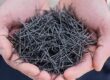

Fibre-reinforced concrete is concrete to which small reinforcing fibres are added during mixing. These fibres are distributed throughout the entire volume of the concrete and primarily help control the formation, opening and propagation of cracks.
However, fibre reinforcement is not a single technology. Fibres of very different sizes, materials and load-bearing capacities are used in concrete, and their functions can also differ significantly.
The most important distinction is that some fibres are primarily intended to reduce early-age shrinkage cracking, while so-called structural fibres are capable of carrying loads even after the concrete has hardened.
Therefore, whenever someone refers to “fibre-reinforced concrete”, the first question should always be:
What type of fibre is in the concrete, and what is its purpose?
What exactly does fibre-reinforced concrete mean?
Traditional concrete is made from cement, water, sand and aggregates of different sizes.
One of concrete’s greatest strengths is its excellent resistance to compressive loads. However, it is considerably more vulnerable to tensile and bending stresses.
This is one of the main reasons why concrete structures often need some form of reinforcement.
The traditional solution is reinforcing steel or welded steel mesh.
In fibre-reinforced concrete, part or, in certain applications, all of this reinforcement is not installed as a separate steel structure. Instead, a large number of small fibres are mixed directly into the fresh concrete.
During mixing, the fibres become distributed throughout the concrete and, once the concrete hardens, become an integral part of the material.
As a result, fibre reinforcement is not concentrated in a single plane but is present throughout the entire volume of the concrete.
Why are fibres added to concrete?
Cracks can develop in concrete for many different reasons.
These may include:
- drying and shrinkage of the concrete,
- temperature changes,
- minor movement of the subbase,
- point loads,
- vehicle traffic,
- bending loads,
- or internal stresses developing within the concrete.
One of the most important functions of fibre reinforcement is to control these cracks.
However, it is important to understand that even properly designed fibre reinforcement does not mean that the concrete will never crack.
One of the key functions of structural fibres is that, once a crack forms, the fibres bridge the two sides of the crack and restrict further crack opening.
This is an important distinction.
It is not only whether a crack forms that matters, but also how the concrete behaves afterwards.
How does fibre reinforcement work?
Imagine a conventional concrete slab containing welded steel reinforcement mesh.
The mesh is positioned at a specific height within the slab, in a single plane.
Fibre reinforcement works differently.
When properly mixed, the fibres are distributed at thousands or even tens of thousands of points throughout the entire concrete volume.
When a small crack begins to develop, fibres crossing the crack connect its two sides.
Suitable structural macrofibres can therefore:
- bridge cracks,
- transfer forces across the crack,
- limit crack opening,
- help distribute stresses,
- and improve the post-cracking load-bearing capacity of the concrete.
This post-cracking behaviour is particularly important in structural fibre reinforcement.
Do all concrete fibres perform the same function?
No.
This is one of the most important things to understand about fibre-reinforced concrete.
The term “concrete fibre” on its own tells us very little about the actual performance of a product.
There can be an enormous difference between a microfibre only a few millimetres long and a 40–50 mm structural macrofibre.
They differ in size, design, load-bearing capacity and, most importantly, in the purpose for which they were developed.
Therefore, it should never be assumed that every fibre that can be mixed into concrete is suitable for replacing welded steel mesh.
Microfibres and macrofibres – what is the difference?
Synthetic concrete fibres can be broadly divided into two main groups.
Microfibres
Microfibres are very thin, short fibres.
Their primary function is generally to reduce shrinkage cracking in fresh and early-age concrete.
These fibres are especially effective during the early stages of concrete hardening.
They can be useful, for example, in:
- floor screeds,
- renders,
- thin concrete layers,
- levelling screeds,
- and applications where the main objective is to reduce early shrinkage cracking.
Conventional microfibres, however, are generally not considered a structural replacement for welded steel reinforcement mesh.
Structural macrofibres
Macrofibres are considerably larger and stronger.
They are specifically designed to transfer forces even after the concrete has hardened.
Their function goes beyond reducing early shrinkage cracking.
A suitable structural macrofibre continues to work after a crack has formed: it bridges the crack, transfers load and restricts further crack opening.
This is what makes it possible, in certain concrete slab applications, to use structural macrofibre reinforcement instead of conventional welded steel mesh.
What materials can concrete fibres be made from?
Fibre-reinforced concrete can be produced using several different types of fibres.
The most common solutions include:
Steel fibres
Steel fibres are mainly used in larger industrial concrete surfaces and specialised structures.
They can provide high load-bearing performance, but because they are made of steel, their material properties must also be considered, including the possibility of corrosion.
Synthetic microfibres
These are generally very thin fibres made from polypropylene.
They are primarily used to reduce shrinkage cracking.
Synthetic macrofibres
These are larger, high-strength polymer-based fibres.
Modern structural macrofibres are not simply “plastic fibres”; they are products specifically engineered for structural concrete reinforcement.
ArmoTec structural macrofibre, for example, belongs to this category.
Other fibres
Glass, basalt and other mineral or synthetic fibres are also used in specialised applications.
This further demonstrates that “fibre-reinforced concrete” is actually a broad collective term.
Can fibre reinforcement replace welded steel mesh?
In certain applications, yes.
But not in every case.
This is one of the most important boundaries in the correct use of the technology.
In ground-supported concrete slabs, welded steel mesh often primarily serves to control cracking and distribute loads.
Typical examples include:
- garage floors,
- driveways,
- workshop floors,
- industrial floors,
- agricultural concrete surfaces,
- pavements,
- terraces,
- and other ground-supported concrete slabs.
With appropriate design, structural macrofibres can replace conventional mesh reinforcement in some of these applications.
The situation is different with beams, suspended slabs, columns and other primary load-bearing reinforced-concrete structures.
In such cases, it cannot generally be stated that reinforcing steel can simply be omitted and replaced with macrofibres.
The appropriate reinforcement must always be determined according to the function of the structure and the loads acting on it.
What is the difference between fibre-reinforced concrete and reinforced concrete?
In reinforced concrete, the reinforcement is generally provided by steel reinforcing bars or welded steel mesh.
These are installed in the correct position inside the structure before the concrete is poured.
In fibre-reinforced concrete, the fibres are mixed directly into the concrete.
This creates three important differences.
1. The fibres are present throughout the concrete
They do not work only within a single predefined plane but are distributed throughout the entire concrete volume.
2. No separate reinforcement installation is required
The fibres do not need to be cut to size, transported into position, tied together or placed on spacers.
3. Their position cannot be incorrectly installed in the same way
Welded steel mesh can only perform correctly if it is actually positioned at the designed depth within the concrete cross-section.
Macrofibres, by contrast, are mixed throughout the entire volume of the concrete.
However, this does not mean that the two technologies can be freely substituted for one another in every situation.
What are the advantages of fibre-reinforced concrete?
Properly designed fibre reinforcement can offer several advantages.
Simpler construction
There is no need to move, cut and position large sheets of welded steel mesh.
The fibres are simply added to the concrete mix.
Faster concreting
Where steel mesh can be eliminated, one of the most labour-intensive parts of preparing for the concrete pour can also be removed.
Three-dimensional reinforcement
The fibres are distributed throughout the concrete volume rather than being concentrated in a single plane.
No corrosion
Polypropylene macrofibres do not rust.
This can be particularly advantageous in wet, outdoor or chemically exposed environments.
Fewer work processes
Transporting, placing, cutting, tying and supporting traditional steel mesh can be partly or entirely eliminated.
More reliable distribution
Properly mixed fibres cannot end up at the bottom of the slab during concreting in the same way as inadequately supported or walked-down steel mesh can.
Are there disadvantages to fibre-reinforced concrete?
Of course.
There is no single reinforcement technology that is the best solution for every application.
With fibre reinforcement, it is particularly important to ensure:
- selection of the correct fibre type,
- correct dosage,
- uniform mixing,
- consideration of the concrete mix design,
- proper construction practices,
- and structural design where required.
If too little fibre is used, the required performance may not be achieved.
If the wrong type of fibre is selected, adding fibres to the concrete does not automatically mean that they can perform the function expected from structural reinforcement.
Therefore, simply “adding some fibres to the concrete” is not the same as designing fibre-reinforced concrete properly.
How much fibre should be added to concrete?
There is no single dosage that is correct in every situation.
The required dosage depends on factors including:
- the type of fibre,
- the thickness of the concrete slab,
- the concrete grade,
- the bearing capacity of the ground or subbase,
- the expected loads,
- vehicle traffic,
- point loads,
- and the function the fibre reinforcement is required to perform.
The dosage of a microfibre and the design of a structural macrofibre system are therefore two completely different questions.
For structural applications, it is not enough simply to determine how many kilograms of fibre should be added per cubic metre of concrete.
The important question is what post-cracking load-bearing capacity the fibre-reinforced concrete provides at that dosage.
What does post-cracking load-bearing capacity mean?
This is one of the most important concepts in understanding structural fibre-reinforced concrete.
Concrete itself is a brittle material.
When a conventional unreinforced concrete test specimen cracks, its load-bearing capacity can decrease very rapidly.
With structural fibres, however, fibres crossing the crack continue to connect the two sides of the concrete.
As a result, the specimen can continue to carry load even after the crack has formed.
For this reason, the performance of structural fibres should not be assessed solely on the basis of the tensile strength or length of the fibre itself.
What matters is how the fibre-reinforced concrete behaves after cracking.
In practice, this is often evaluated using the CMOD value (Crack Mouth Opening Displacement), which describes the width of the crack opening. It shows how far the crack opens under a given load and therefore provides a direct indication of how effectively the fibres bridge the crack and help the concrete continue carrying load.
Where is fibre-reinforced concrete used?
The technology has a very wide range of applications.
Structural macrofibres and other fibre-reinforcement solutions are used, for example, in:
- industrial floors,
- logistics centres,
- warehouses,
- car parks,
- agricultural buildings,
- roads and concrete yards,
- tunnels,
- precast concrete elements,
- garages,
- driveways,
- workshops,
- terraces,
- pavements,
- and other concrete slabs.
The correct fibre type always depends on the function the fibre reinforcement needs to perform.
Can fibre-reinforced concrete be made on small projects?
Yes.
However, once again, this depends on the type of fibre reinforcement being used.
Structural macrofibres are now available in smaller packaging sizes, so the technology is no longer limited to concrete plants and large industrial projects.
ArmoTec structural macrofibre, for example, can be added directly to a concrete mixer or to ready-mixed concrete.
The key requirement is uniform mixing.
The fibres can only perform correctly if they are evenly distributed throughout the entire concrete volume.
Is fibre-reinforced concrete stronger than conventional concrete?
This question cannot be answered with a simple yes or no.
The “strength” of concrete can refer to several different properties.
Fibre reinforcement is not necessarily added to significantly increase compressive strength.
Its main advantages are generally seen in the tensile, flexural and post-cracking behaviour of the concrete.
Suitable structural fibres can make the behaviour of the structure more ductile, improve its ability to carry load after cracking and increase its resistance to crack opening.
In many applications, this is more important than simply increasing the compressive strength of the concrete.
So what is fibre-reinforced concrete?
In short:
Fibre-reinforced concrete is concrete in which fibres mixed into the concrete help control cracking, distribute stresses and – in the case of structural fibres – continue to transfer load after cracks have formed.
However, the term “fibre-reinforced concrete” alone does not tell us what performance a particular structure can achieve.
The key questions are always:
What type of fibre is being used?
At what dosage?
In what type of concrete?
In what type of structure?
And what function must the fibre perform?
Once these questions have been answered, we are no longer simply talking about “concrete with fibres”, but about properly designed fibre-reinforced concrete.
Frequently asked questions about fibre-reinforced concrete
What is fibre-reinforced concrete?
Fibre-reinforced concrete is concrete into which different types of reinforcing fibres are mixed. The fibres are distributed throughout the concrete volume and, depending on their type, can help reduce shrinkage cracking or provide structural reinforcement.
Can fibres replace welded steel mesh?
Not all fibres can. Suitable structural macrofibres can replace conventional welded steel mesh in certain ground-supported concrete slabs. However, this cannot be stated generally for primary load-bearing reinforced-concrete structures.
What is the difference between microfibres and macrofibres?
Microfibres are primarily used to reduce early-age shrinkage cracking. Structural macrofibres are larger and stronger and can transfer loads by bridging cracks in hardened concrete.
Does fibre-reinforced concrete rust?
That depends on the fibre material. Steel fibres can corrode, while synthetic polypropylene macrofibres do not rust.
How much macrofibre is needed per cubic metre of concrete?
The required dosage depends on the application, slab thickness, subbase and expected loads. For structural applications, the dosage should be determined based on these conditions and the required performance.
Can fibre-reinforced concrete be used for garages and driveways?
Yes. Ground-supported garage floors and driveways are typical applications for structural macrofibre-reinforced concrete, provided the slab thickness, subbase and fibre dosage are appropriate.
Can reinforcing steel and fibre reinforcement be used together?
Yes. The two technologies do not exclude each other. In some structures, fibres can be used as additional reinforcement alongside conventional steel reinforcement.