
Concrete is one of the most widely used construction materials, but it has one characteristic that can cause problems: it is extremely strong under compression but much weaker under tensile stress. As a result, cracks can develop in concrete, sometimes appearing within just a few hours after pouring.
Various types of fiber reinforcement have long been used to reduce the formation and propagation of cracks. In recent years, synthetic fibers mixed directly into concrete have become increasingly popular. They can simplify concrete construction and, in certain applications, even make it possible to replace traditional steel reinforcement mesh.
However, not all synthetic fibers used in concrete are designed for the same purpose.
There are two main categories on the market: microfibers and macrofibers. Although both are mixed into fresh concrete, their functions and applications differ significantly.
In this article, we explain exactly what these fibers do, when to choose each type, and which common mistakes you should avoid.
1. Why Does Concrete Need Fiber Reinforcement?
To understand the difference between microfibers and macrofibers, we first need to look at why concrete cracks.
Fresh concrete consists of cement, water, sand, gravel, and, when necessary, various chemical admixtures.
During the chemical reaction between cement and water, the concrete gradually hardens. However, several processes can occur during this period that may lead to cracking.
These include:
- Rapid evaporation of water from the fresh concrete surface.
- Reduction in concrete volume, also known as shrinkage.
- Deformation caused by temperature changes.
- Loads acting on the concrete.
- Uneven settlement of the subgrade or inadequate support.
Different types of cracks can develop at different stages and for different reasons.
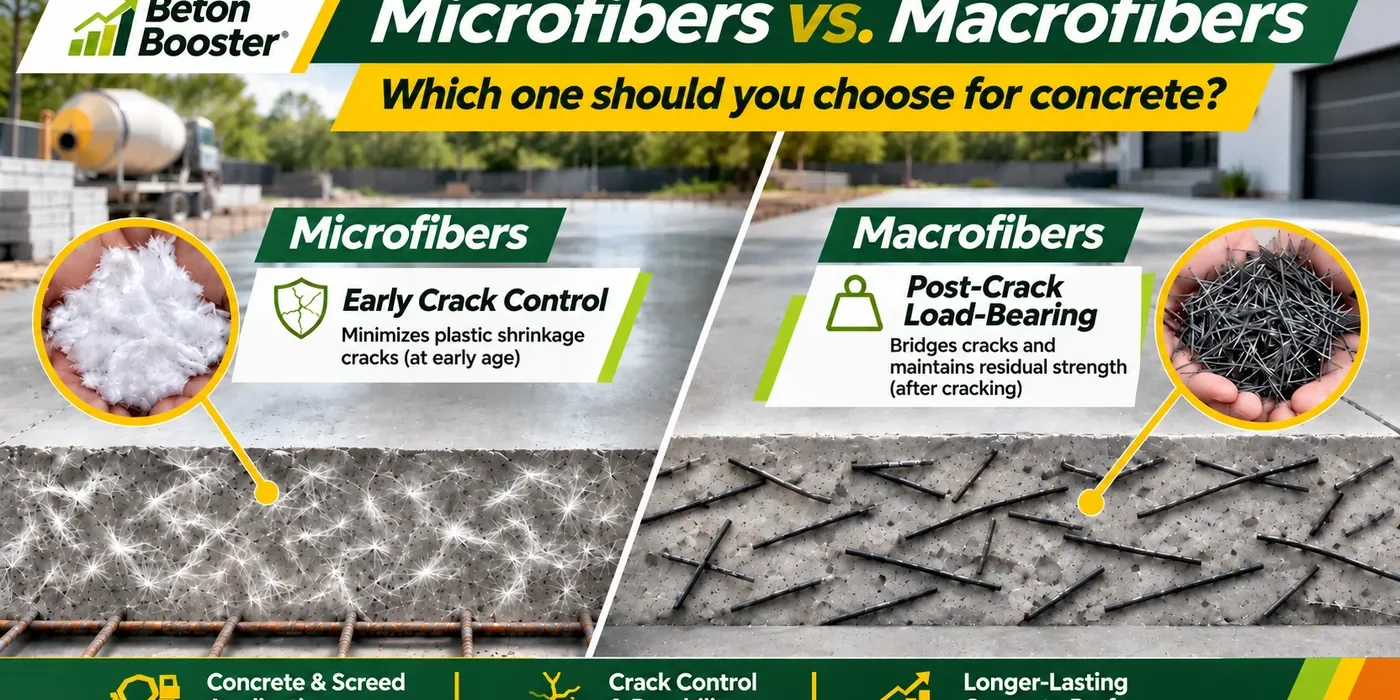
Reducing early-age cracking in fresh concrete and improving the post-cracking load-bearing capacity of hardened concrete are two different tasks.
This is the most important distinction between microfibers and macrofibers.
2. What Are Microfibers and How Do They Work?
Microfibers are extremely thin synthetic fibers, typically made from polypropylene, that are added to concrete during mixing.
Under the European standard EN 14889-2, microfibers have an equivalent diameter of less than 0.3 millimeters. Their length varies depending on the product but generally ranges from a few millimeters to several centimeters.
One of their most important characteristics is that they are distributed throughout the concrete in very large numbers.
How Do Microfibers Help?
When the surface of fresh concrete loses moisture too quickly, the upper layer may begin to shrink.
If the stresses caused by shrinkage exceed the tensile strength of the young concrete, small cracks may appear on the surface.
Properly selected and dosed microfibers help reduce the formation and propagation of these early cracks, known as plastic shrinkage cracks.
However, it is important to understand that microfibers primarily provide benefits during the early stages of concrete hardening.
Conventional microfibers alone are not suitable for providing significant structural load-bearing capacity in hardened concrete.
When Should You Use Microfibers?
Microfibers can be particularly useful for:
- Floor screeds.
- Concrete subfloors.
- Thin concrete layers.
- Large concrete surfaces where rapid moisture evaporation is expected.
- Concrete mixes where reducing early-age shrinkage cracking is the main objective.
The FiberMix microfiber product in the Beton Booster range is designed for this purpose.
Can Microfibers Replace Steel Reinforcement Mesh?
No.
This is one of the most common misconceptions about fiber-reinforced concrete.
Adding microfibers to concrete does not automatically turn it into structurally reinforced concrete in which steel reinforcement mesh can be omitted.
If a concrete slab requires steel mesh or another form of structural reinforcement to achieve adequate load-bearing capacity, conventional microfibers cannot replace it.
3. What Are Macrofibers and How Do They Differ from Microfibers?
Macrofibers can also be made from polypropylene, but their design and purpose are fundamentally different from those of microfibers.
Under EN 14889-2, Class II macrofibers have an equivalent diameter of at least 0.3 millimeters. Macrofibers manufactured for structural applications are typically several centimeters long.
The surface and shape of suitable macrofibers are designed to develop an effective bond with the surrounding cement matrix after the concrete has hardened.
How Do Macrofibers Work?
Imagine a hardened concrete slab in which a small crack develops under loading.
In ordinary unreinforced concrete, this crack may continue to widen because concrete has limited tensile strength.
Properly dosed structural macrofibers, however, can bridge cracks as they develop.
The fibers crossing the crack transfer forces between the two sides, allowing the structure to retain significant load-bearing capacity even after cracking.
This property is known as residual post-cracking load-bearing capacity.
It is this characteristic that makes it possible to use suitable structural macrofibers instead of conventional steel reinforcement mesh in certain structures.
Where Can Structural Macrofibers Be Used?
With appropriate design and dosage, they can be used in applications such as:
- Ground-supported concrete slabs.
- Driveways and garage floors.
- Sidewalks and garden paths.
- Industrial floors.
- Ground-supported concrete terrace slabs.
- Certain foundation slabs and other specifically engineered structures.
However, suitability always depends on the structure’s design, loading conditions, support conditions, and the verified performance of the selected macrofiber.
Important: Structural macrofibers are not a universal replacement for all steel reinforcement.
For example, they must not automatically be used instead of reinforcing steel in suspended slabs, beams, columns, or other major load-bearing structural elements.
Such applications require specific structural engineering and verification of the proposed solution.
4. Microfibers vs. Macrofibers: The Key Differences
The easiest way to understand the two fiber reinforcement solutions is to compare them side by side.
| Property | Microfibers | Structural Macrofibers |
|---|---|---|
| Fiber diameter | Less than 0.3 mm | At least 0.3 mm |
| Primary purpose | Reduce early-age shrinkage cracking | Improve post-cracking load-bearing capacity |
| Replacement of steel mesh | Not suitable | Possible in certain structures |
| Typical applications | Screeds, concrete subfloors | Driveways, industrial floors, ground-supported slabs |
| Dosage | Generally lower | Generally higher |
| Effect in hardened concrete | Limited structural effect | Verifiable residual load-bearing capacity |
The table clearly shows that microfibers and macrofibers are not simply cheaper or more expensive versions of the same product. They are two different types of reinforcement designed to perform different functions.
5. Which Fiber Should You Choose for Different Concrete Applications?
The right choice always depends on the purpose of the concrete construction.
Floor Screeds and Underfloor Heating
When installing a screed over underfloor heating, correct layer thickness, shrinkage management, and crack control are particularly important.
If the main objective is to reduce early-age shrinkage cracking, microfibers may be a suitable choice.
However, if the screed design requires verified residual post-cracking load-bearing capacity, suitable macrofibers may also be considered.
The presence of underfloor heating alone does not automatically justify choosing macrofibers.
The decision must also take into account the complete floor construction, expected loads, and the requirements of the screed system.
Driveways and Garage Floors
For concrete slabs regularly subjected to passenger vehicle traffic, load-bearing capacity is just as important as crack control.
If the aim is to replace traditional steel reinforcement mesh in the planned slab, suitable structural macrofibers must be selected.
Microfibers alone cannot provide the structural performance required for this purpose.
However, dosage should not be determined solely by slab thickness. Vehicle loads, subgrade bearing capacity, and concrete quality are also important factors.
Garden Paths and Terraces
Several reinforcement solutions may be appropriate for ground-supported concrete surfaces exposed to relatively light loads.
If the primary objective is to reduce early-age shrinkage cracking in fresh concrete, microfibers may be sufficient.
However, if the slab requires structural reinforcement and the aim is to replace steel mesh, properly designed macrofiber-reinforced concrete may be an option.
Industrial Floors and Warehouses
Loads acting on industrial floors can be significantly higher than those typically encountered around residential buildings.
Forklifts, pallet racking, machinery, and other equipment can subject concrete floors to considerable stress.
Structural macrofiber-reinforced concrete can be an effective solution in such environments, but the fiber dosage and floor structure must always be determined through appropriate engineering calculations.
6. How Much Microfiber or Macrofiber Should Be Added to Concrete?
The effectiveness of fiber reinforcement depends not only on the fiber material but also on its quantity, shape, dimensions, and distribution throughout the concrete.
Microfiber Dosage
Conventional polypropylene microfibers are often used at approximately 0.3–0.9 kg/m³, although the exact dosage depends on the product and intended application.
The appropriate quantity should be selected according to the manufacturer’s instructions and the required performance.
Structural Macrofiber Dosage
Structural macrofibers are generally used at higher dosages.
For example, the following starting quantities may be considered for certain ground-supported concrete slabs using Beton Booster ArmoTec macrofibers:
- Lightly loaded surfaces intended for pedestrian traffic: approximately 2.5–3 kg/m³.
- Surfaces subjected to passenger vehicle traffic: approximately 4 kg/m³.
- More heavily loaded or specialized structures: sometimes 5–6 kg/m³ or an individually determined dosage.
These figures are indicative application examples, not universally applicable structural design specifications.
The quantity required for any particular project must always be determined according to the structural requirements and verified properties of the selected product.
Example: Calculating Fiber Requirements
Suppose you want to construct a 50 m² driveway with a concrete slab thickness of 10 cm.
The required concrete volume is:
50 m² × 0.10 m = 5 m³
If a dosage of 4 kg/m³ of ArmoTec has been verified as suitable for the particular structure, the total fiber requirement is:
5 m³ × 4 kg/m³ = 20 kg of ArmoTec macrofibers.
The calculation itself is simple, but it is important to distinguish between calculating the required quantity and determining the technically appropriate dosage.
7. Can Microfibers and Macrofibers Be Used Together?
Yes. Some concrete mixes contain both types of fiber.
The reason is that they perform different functions.
Microfibers primarily help reduce early-age shrinkage cracking, while macrofibers improve the post-cracking behavior of hardened concrete.
In certain applications, the two types of reinforcement can therefore complement each other.
However, this does not mean that both should automatically be added to every concrete mix.
Using different fibers together can affect the workability of fresh concrete, so adjustments to the mix design may also be necessary.
The appropriate solution should be selected based on the intended application and the manufacturer’s recommendations.
8. What Does the EN 14889-2 Standard Mean?
When purchasing synthetic fibers for concrete, it is worth checking which standards and performance requirements the product meets.
The European standard EN 14889-2 covers polymer fibers used in concrete, mortar, and grout.
The standard distinguishes between Class I microfibers and Class II macrofibers.
However, simply stating that a product complies with EN 14889-2 does not prove that it can replace any type of steel reinforcement mesh in structural applications.
The product’s actual performance characteristics must also be evaluated.
What Is Residual Flexural Tensile Strength?
One important test method for fiber-reinforced concrete is the bending test specified in EN 14651.
During this test, a specially prepared concrete specimen is subjected to loading, and its behavior after cracking is measured.
The degree of crack opening is expressed as a CMOD value.
CMOD stands for Crack Mouth Opening Displacement, which describes the width of the crack opening at the specified measurement location.
The test results can be used to determine the residual flexural tensile strength of fiber-reinforced concrete at different crack opening widths.
This provides much more meaningful information about the actual performance of structural macrofibers than fiber length or the tensile strength indicated on the product packaging alone.
Two different macrofibers used at the same dosage in kilograms per cubic meter do not necessarily provide the same structural performance.
9. What Common Mistakes Should Be Avoided When Using Fiber-Reinforced Concrete?
The benefits of fiber reinforcement can only be achieved when the fibers are used correctly.
1. Using Microfibers Instead of Steel Mesh
This can be a serious mistake if the concrete slab requires structural reinforcement.
Conventional microfibers cannot replace properly designed structural reinforcement.
2. Using Too Little Macrofiber
The performance of macrofiber-reinforced concrete depends heavily on dosage.
If the quantity of fibers is insufficient, the required post-cracking load-bearing capacity may not be achieved.
3. Failing to Mix the Fibers Properly
Fibers must be distributed evenly throughout the concrete.
Improper mixing can lead to fiber clumps or uneven reinforcement.
It is therefore essential to follow the mixing instructions for the selected product.
4. Adding Too Much Water to the Concrete
Adding fibers may change the workability of fresh concrete.
However, this should not simply be compensated for by adding more water.
An excessively high water-cement ratio can negatively affect concrete strength, durability, and shrinkage properties.
Suitable concrete admixtures should be used when necessary.
5. Neglecting Concrete Curing
Fiber reinforcement does not replace proper curing.
Fresh concrete must be protected against excessively rapid drying, unfavorable temperature conditions, and premature loading.
Correct concreting procedures, appropriate joint design, and proper curing remain essential requirements.
10. What Are the Advantages of Structural Macrofiber-Reinforced Concrete?
One of the greatest advantages of properly designed macrofiber-reinforced concrete is that it can simplify construction compared with traditional steel mesh reinforcement in certain applications.
If structural macrofibers have been verified as a suitable replacement for steel mesh, several construction steps can be eliminated.
For example, there may be no need to transport, cut, adjust, tie, or position steel reinforcement mesh on site.
Macrofibers are mixed directly into the concrete, distributing reinforcement throughout its volume.
This can be particularly beneficial in projects where placing steel mesh would otherwise be difficult or time-consuming.
Another advantage is that polypropylene macrofibers do not corrode in the same way as conventional steel.
When appropriately specified and applied, structural macrofiber reinforcement can therefore save labor, time, and money.
However, actual savings depend on the size of the project, loading conditions, required quantity of steel mesh, selected macrofiber dosage, and local labor costs.
11. Frequently Asked Questions
Can All Synthetic Fibers Replace Steel Reinforcement Mesh?
No. Conventional microfibers are not suitable for this purpose. However, certain structural macrofibers with verified performance may replace steel mesh in specific structures, provided that the engineering design and technical requirements allow it.
Will Concrete Be Completely Crack-Free If Fibers Are Added?
No. Fiber reinforcement can reduce the risk of certain types of cracking and help limit crack widths, but it cannot guarantee completely crack-free concrete.
Can Macrofibers Be Used in Screeds with Underfloor Heating?
Yes, provided that the selected product is suitable for the particular screed system and its application complies with the design requirements and manufacturer’s instructions.
Do Macrofibers Make Concrete Stronger?
Suitable macrofiber reinforcement primarily improves the post-cracking load-bearing capacity and toughness of concrete. However, it should not automatically be assumed that macrofibers significantly increase concrete compressive strength.
Which Is More Cost-Effective: Microfibers or Macrofibers?
Comparing the prices of the two products alone is not particularly meaningful because they perform different functions.
Microfibers are used to reduce early-age cracking, while suitable structural macrofibers may provide an alternative to steel reinforcement mesh in certain structures.
In the latter case, it is worth comparing the total construction cost rather than simply the price per kilogram of fiber.
12. Conclusion: When Should You Choose Microfibers or Macrofibers?
Understanding the difference between microfibers and macrofibers is essential when selecting the right concrete reinforcement technology.
Microfibers are the appropriate choice when the primary objective is to reduce early-age plastic shrinkage cracking in fresh concrete.
Structural macrofibers should be considered when the aim is to improve the post-cracking load-bearing capacity of hardened concrete or, with appropriate structural design, replace conventional steel reinforcement mesh.
The Beton Booster product range offers solutions for both purposes.
FiberMix microfibers are designed to reduce early-age shrinkage cracking, while ArmoTec and OneShot Macro 45 structural macrofibers can be used to reinforce appropriately designed and engineered concrete surfaces.
The most important consideration is not simply choosing a fiber that can be mixed into concrete, but selecting a solution that meets the requirements of the particular structure.
Would you like to know how much structural macrofiber you may need for your concrete project?
Use the Beton Booster online calculator to determine the required concrete volume based on the area and thickness of your planned slab, and calculate the corresponding fiber quantity for your selected dosage.
Beton Booster – Fiber-Reinforced Concrete Solutions
By choosing the right type of fiber, concrete construction can become simpler, more cost-effective, and more durable.