


Description
OneShot Fiber Macro 45 – Structural Macro Fiber for Concrete Reinforcement
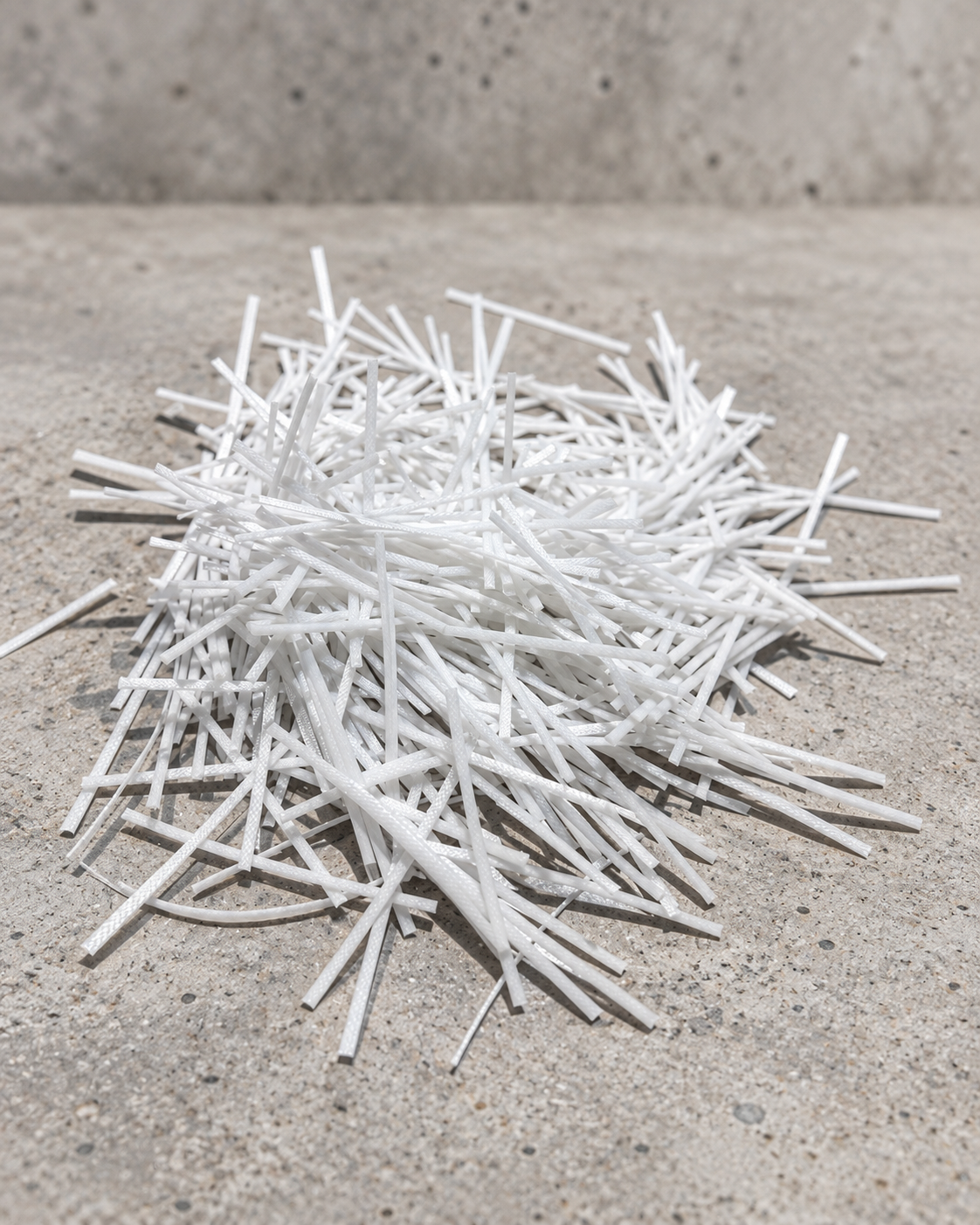
OneShot Fiber Macro 45 is a 45 mm long structural macro fiber made from polypropylene, developed for the structural reinforcement of concrete.
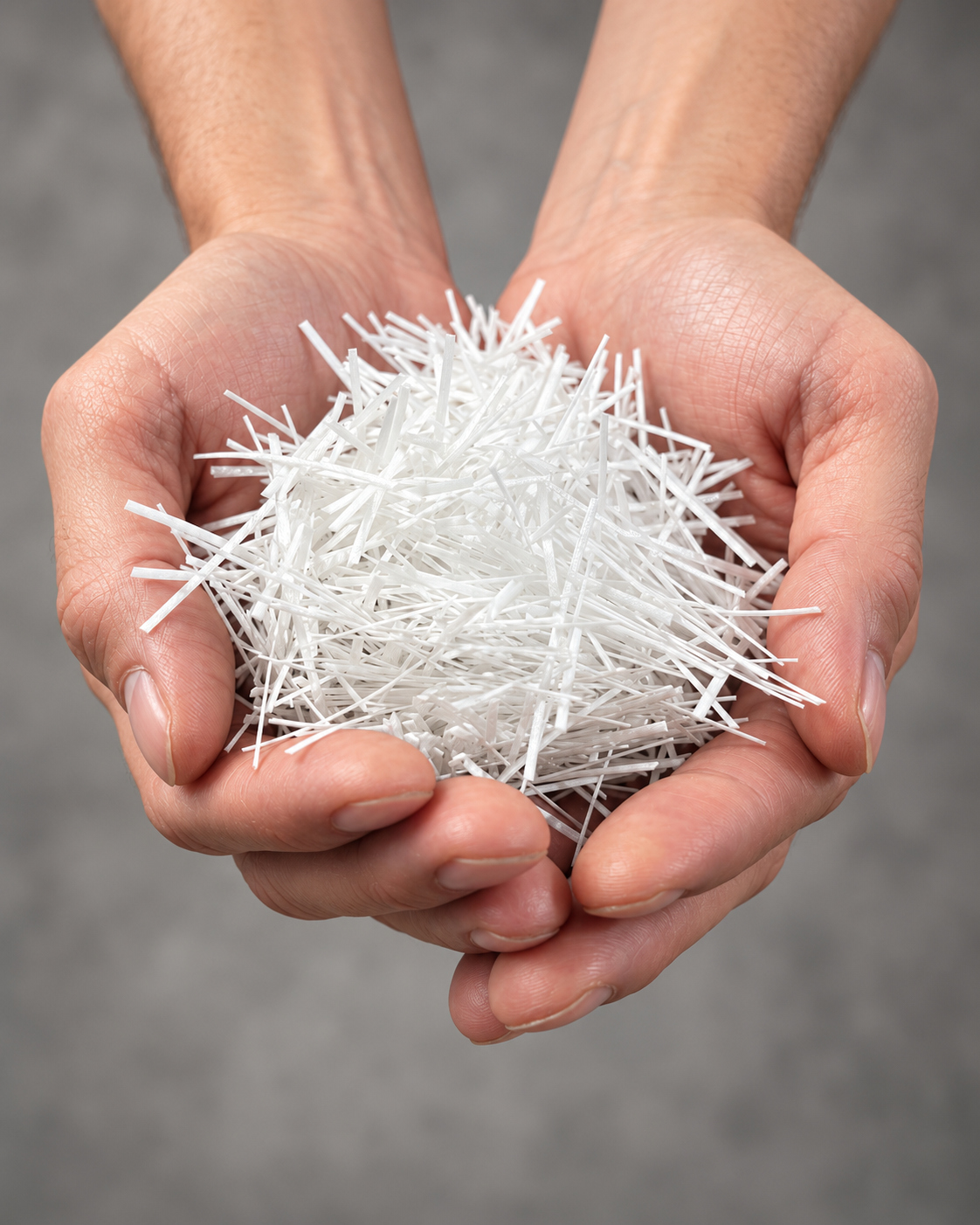
The fibers are mixed directly into fresh concrete. During mixing, tens of thousands of fibers are distributed throughout the entire volume of the concrete, reinforcing it throughout the full cross-section rather than in a single plane like traditional steel mesh.
With proper design and dosage, OneShot Macro 45 may also be suitable for partially or fully replacing secondary steel mesh reinforcement, particularly in ground-supported concrete slabs.
One of the main advantages of the system is that it can significantly simplify concreting work: there is no need to transport, cut, tie or position steel mesh on spacers.
How does structural macro fiber work?
Concrete itself performs very well under compression, but is considerably weaker under tension.
When a crack forms in the concrete, properly distributed macro fibers bridge the crack. The fibers maintain a connection between the two sides of the crack and help transfer loads across it.
This is what distinguishes structural macro fibers from conventional microfibers.
OneShot Macro 45 is not only designed to reduce early shrinkage cracking in fresh concrete, but also contributes to the post-cracking load-bearing performance of hardened concrete.
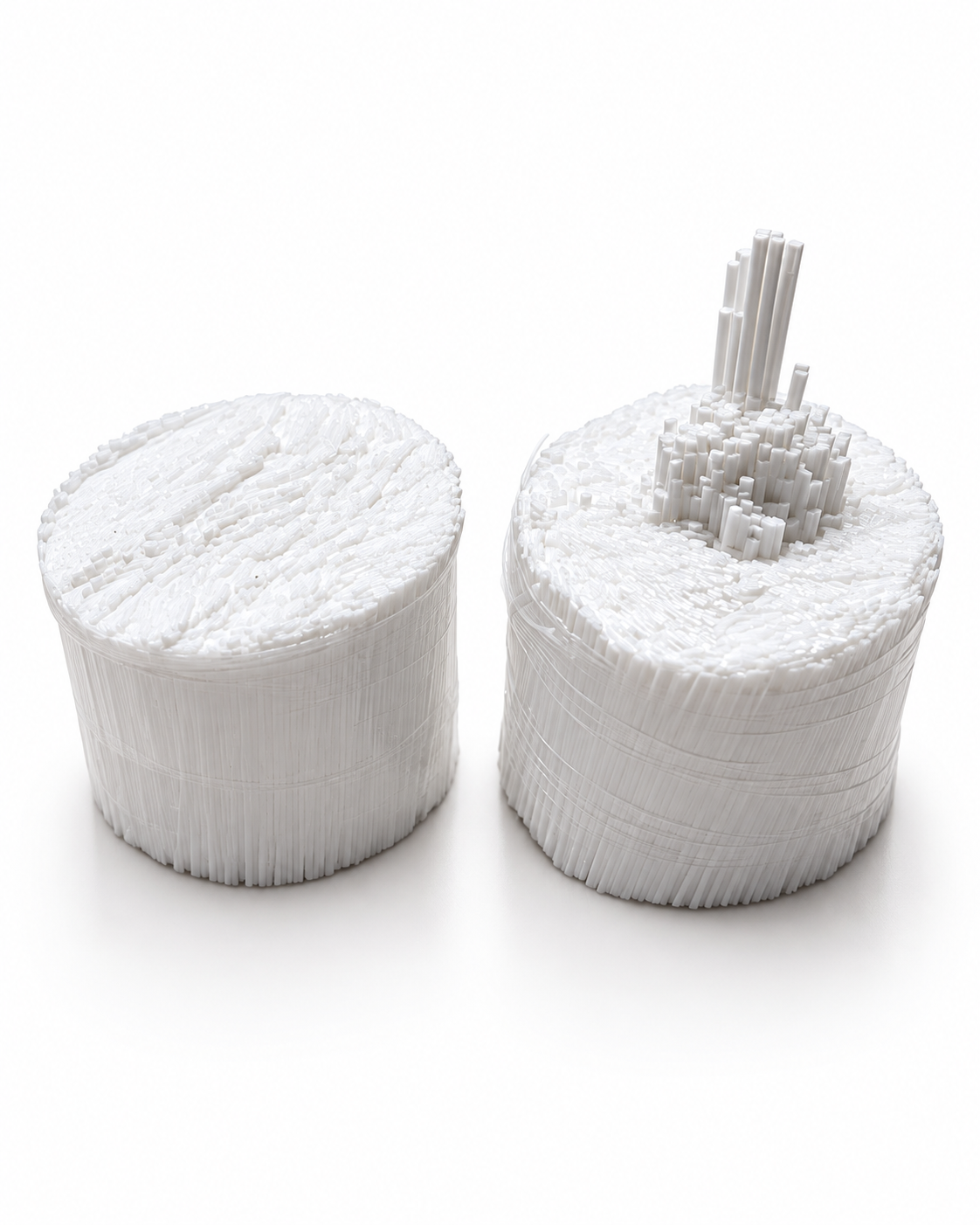
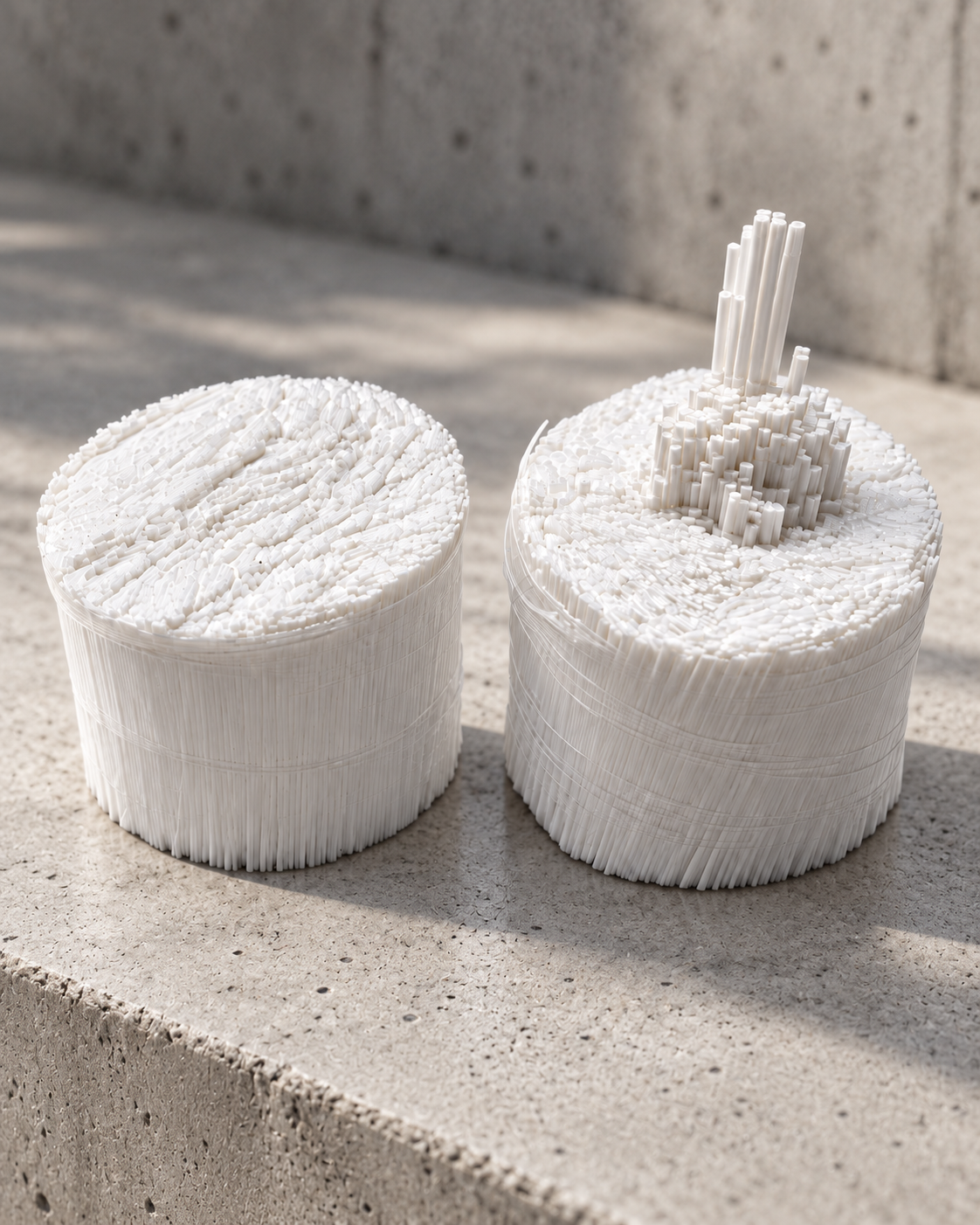
More than 45,000 fibers in every kilogram
According to the manufacturer’s technical data sheet, 1 kilogram of OneShot Fiber Macro contains more than 45,000 individual fibers.
When properly mixed, the fibers form a three-dimensional reinforcement system throughout the full volume of the concrete.
This is a major difference compared with traditional steel mesh.
Steel mesh is positioned in a defined plane within the concrete, while macro fibers are distributed throughout the entire cross-section.
Where can OneShot Macro 45 be used?
OneShot Macro 45 can be used in a wide range of concrete applications, including:
- garage floors
- driveways
- terraces
- pavements and walkways
- yard concrete surfaces
- blinding concrete
- floor screeds and base slabs
- agricultural concrete surfaces
- industrial floors
- concrete pavements
- precast concrete elements
- shotcrete
- concrete surfaces exposed to higher loads
The correct dosage must always be determined based on the design of the structure, slab thickness, support conditions and expected loads.
Can it replace steel mesh?
In certain concrete slabs, yes.
One of the main applications of structural macro fibers is the partial or complete replacement of secondary reinforcement in ground-supported concrete slabs.
Typical examples include properly designed:
- garage floors
- driveways
- terraces
- yard slabs
- walkways
- workshop floors
- agricultural or industrial floors
However, macro fibers are not a universal replacement for all steel reinforcement.
In beams, suspended slabs, columns, ring beams, cantilevers, lintels or other load-bearing structures, designed steel reinforcement must not automatically be replaced with macro fibers.
Structural calculations are required in all such cases.
Why does it make concreting easier?
When traditional steel mesh is used, it must be:
- transported to the site
- handled and moved
- cut to size
- tied where necessary
- placed on suitable spacers
- kept in the correct position during concreting
Macro fibers, by contrast, are mixed directly into the concrete.
Once properly distributed, the reinforcement is already inside the concrete, eliminating a separate mesh installation stage.
This can provide significant savings in both time and labour, especially on smaller concrete projects.
It does not rust
OneShot Macro 45 is made from polypropylene.
Polypropylene does not corrode, so the fibers are not damaged by moisture in the same way as steel.
This can be particularly beneficial in wet environments, outdoor concrete structures or applications where long-term corrosion exposure may be a concern.
According to the manufacturer’s technical documentation, the fibers have zero water absorption and high alkali resistance.
High tensile strength
According to the manufacturer’s data, the tensile strength of OneShot Fiber Macro is:
530–580 MPa
Its modulus of elasticity is:
7.5 GPa
The high tensile strength enables the fibers to transfer loads across cracks that develop in the concrete.
The purpose of the fiber is not to guarantee that concrete will never crack, but to help the structure perform more effectively after cracking has occurred.
Verified residual strength
One of the most important indicators of fiber reinforcement performance is the behaviour of hardened concrete after cracking.
This is measured, among other methods, by CMOD testing.
CMOD describes how concrete behaves once a crack has already formed and gradually begins to open.
This is where structural macro fibers become particularly important: fibers crossing the crack continue to connect the two sides of the concrete.
For this reason, the performance of macro fibers should not be judged only by fiber length or tensile strength. The residual performance of the fiber-reinforced concrete is equally important.
What dosage is required?
The general dosage range specified by the manufacturer for OneShot Fiber Macro is:
2–7 kg/m³ of concrete
General dosage:
3 kg/m³ of concrete
This means that, depending on the intended use, several kilograms of fiber are typically required per cubic metre of concrete.
However, dosage should not be determined based solely on the volume of concrete.
Factors that should be considered include:
- the thickness of the concrete slab
- the concrete grade
- the design of the soil or sub-base
- the expected load
- point loads
- joint spacing
- the dimensions of the structure
- the structural role the fiber reinforcement is expected to perform
The higher the structural demand, the more important it becomes to determine the correct dosage accurately.
How should it be mixed into concrete?
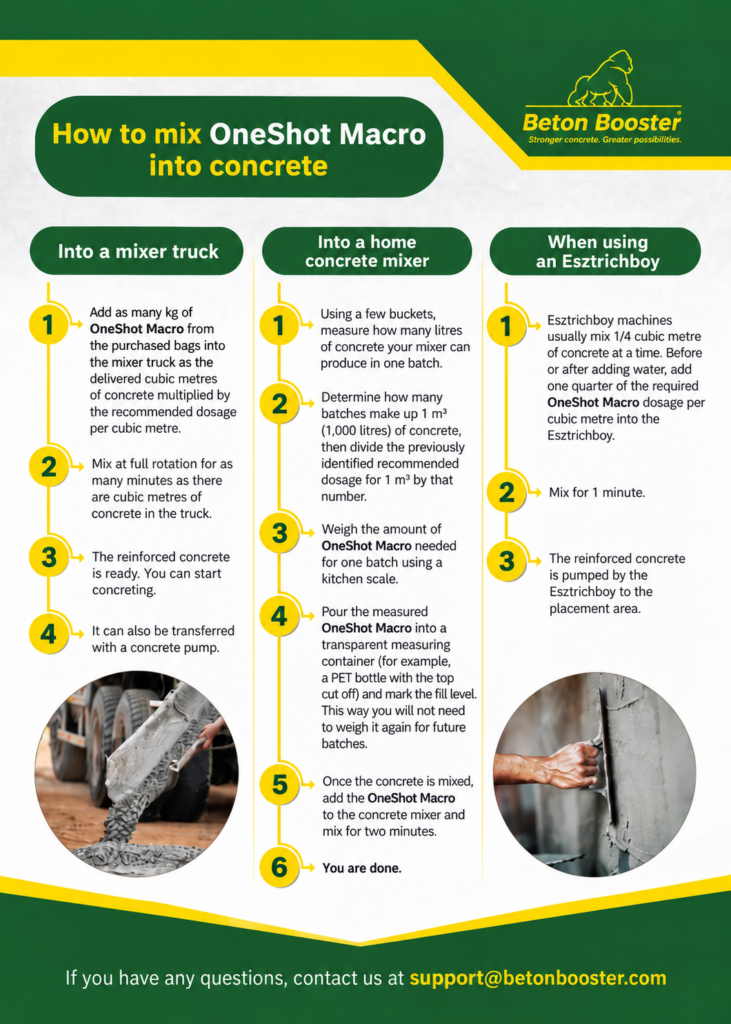
OneShot Macro 45 can be added directly to the concrete.
In ready-mix concrete production, the fibers can be added during the mixing process.
For on-site concreting, under suitable conditions, the fibers may also be added directly to the fresh concrete in the mixer truck.
The most important requirement is to ensure that the fibers are evenly distributed throughout the entire concrete volume.
The goal is not to have large concentrations of fibers in certain areas, but to create uniform fiber reinforcement throughout the concrete.
At higher dosage rates, the fibers may affect the workability of the fresh concrete, so the concrete mix design or consistency may need to be adjusted accordingly.
Not a microfiber
It is important to distinguish between microfibers and structural macro fibers.
The two products are designed for different purposes.
Microfibers are typically very thin and short. They are mainly used to reduce early-age plastic shrinkage cracking in fresh concrete.
OneShot Macro 45, by contrast, is a 45 mm long structural macro fiber.
Its purpose is to improve the structural behaviour of hardened concrete and support load transfer across cracks.
For this reason, the dosage and applications of these two types of fiber differ significantly.
Main technical data of OneShot Fiber Macro 45
Material: polypropylene
Fiber length: 45 mm
Thickness: 0.7 mm
Tensile strength: 530–580 MPa
Modulus of elasticity: 7.5 GPa
Density: 0.90–0.92 g/cm³
Melting point: 168 °C
Water absorption: none
Alkali resistance: high
Number of fibers: more than 45,000 pcs/kg
Manufacturer’s dosage range: 2–7 kg/m³
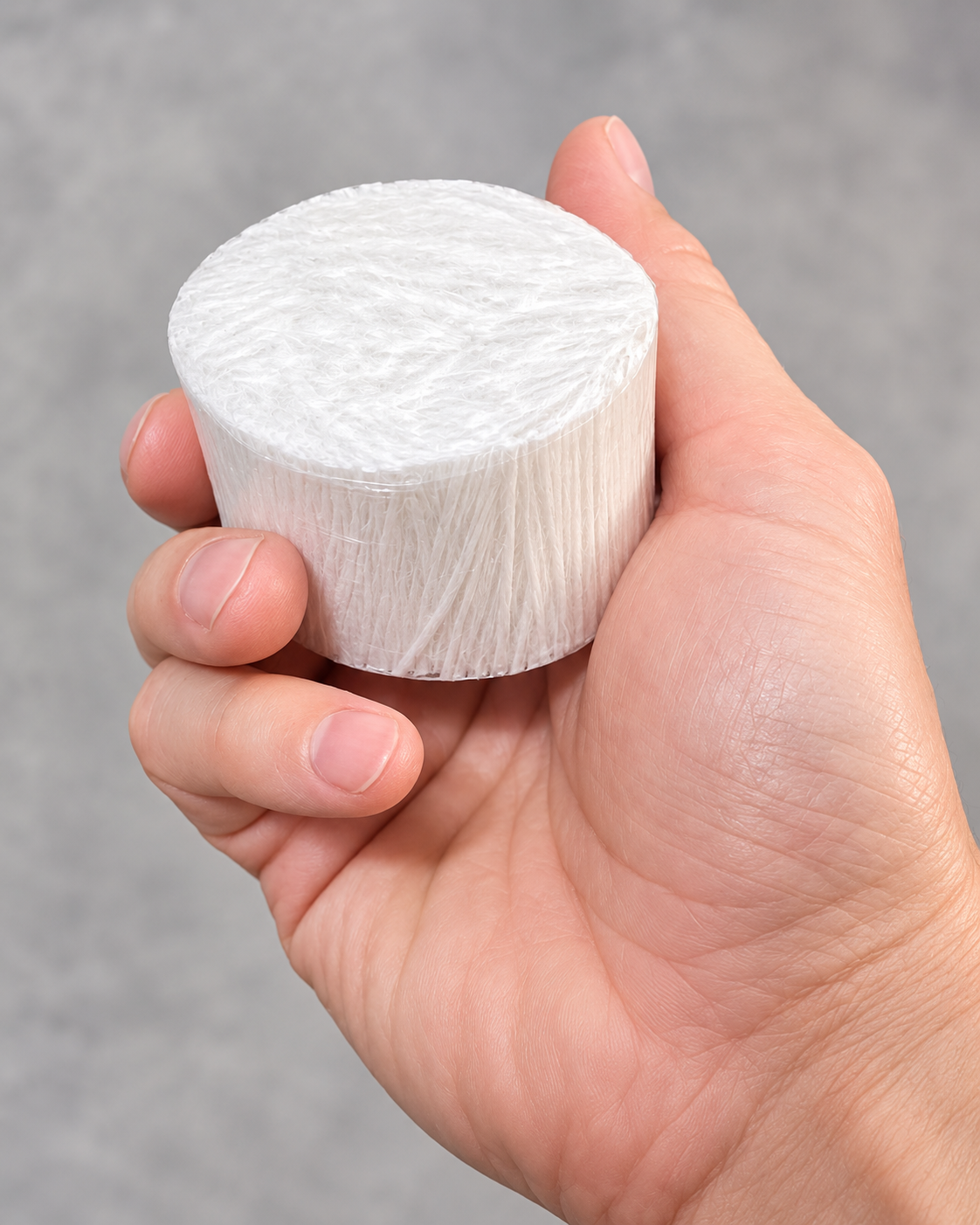
Packaging: 1 kg
The above technical values are stated in the manufacturer’s OneShot Fiber Macro technical data sheet.
What should you pay attention to when concreting?
Macro fiber reinforcement cannot compensate for a poorly designed or incorrectly constructed concrete structure.
For a good final result, the following are still essential:
- a properly prepared and compacted sub-base
- appropriate concrete quality
- correct slab thickness
- proper joint design
- professional placement and finishing
- adequate compaction
- proper curing
Fiber reinforcement performs correctly when these basic requirements are also met.
Concrete can still crack
It is important to understand that no concrete reinforcement system can guarantee completely crack-free concrete under all conditions.
Concrete naturally shrinks, and cracks may develop as a result of various loads and movements.
The purpose of correctly designed macro fiber reinforcement is not necessarily to prevent every crack from forming.
Its primary role is to help control crack width, influence crack propagation and improve the post-cracking load-bearing capacity of the concrete.
When is a structural engineer required?
For simple ground-supported concrete slabs, a general macro fiber dosage can often be determined.
However, structural calculations are required for higher loads, unusual structural designs or load-bearing structures.
Consulting a structural engineer is particularly recommended for:
- heavy-duty industrial floors
- high axle loads
- areas under racking systems
- high point loads
- suspended slabs
- beams
- columns
- cantilever structures
- retaining walls
- any structure where steel reinforcement performs a primary load-bearing function
Summary
OneShot Fiber Macro 45 is a high-performance, 45 mm structural polypropylene macro fiber that is distributed throughout the entire volume of the concrete and helps bridge cracks and transfer loads.
Its main advantages include:
- easy mixing directly into concrete
- more than 45,000 fibers per kilogram
- distribution throughout the full cross-section of the concrete
- no corrosion
- high tensile strength
- resistance to wet and alkaline environments
- potential reduction in steel mesh installation work
- with proper design, suitability for replacing secondary reinforcement in ground-supported concrete slabs
OneShot Macro 45 can be an excellent solution if you are looking for a simpler, faster and more modern concrete reinforcement technology as an alternative to traditional steel mesh.
Information
- OneShot CE Certificate
- OneShot Declaration of Performance
- OneShot Catalogue
- OneShot Macro 45 Type Test Report
Step-by-step macro fiber mixing infographic