
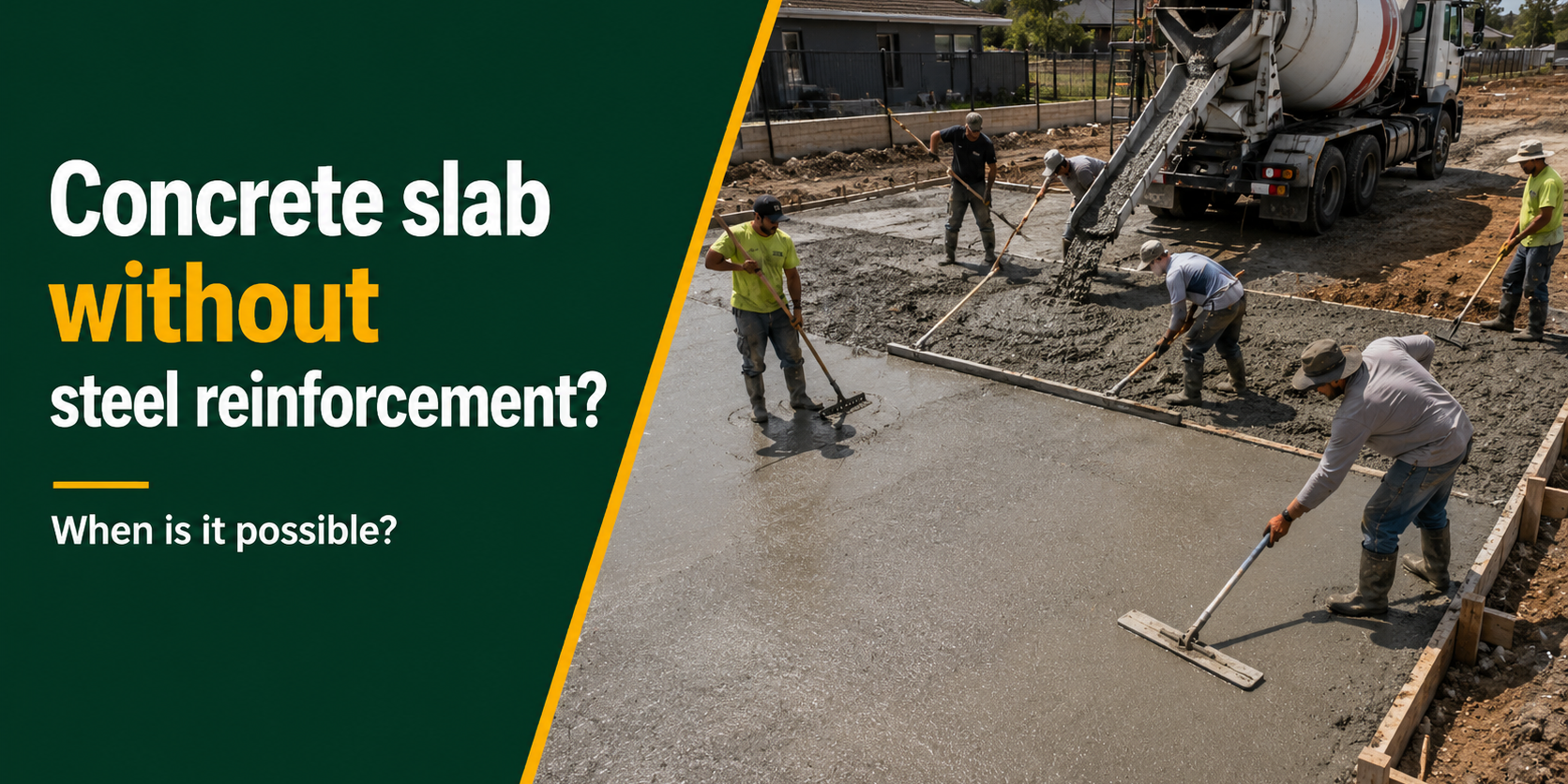
A concrete slab without steel reinforcement may sound unusual at first.
For many people, concrete and steel mesh naturally belong together. So if you want to pour a slab for a garage, driveway, terrace, workshop, garden shed or storage area, the question quickly comes up:
Do you always need steel mesh in the concrete?
The short answer is:
Not always.
In many ground-supported concrete slabs, traditional steel mesh can be replaced with structural macro fibers. This is especially true when the steel mesh is used as secondary reinforcement.
In that case, its two main functions are:
- load distribution
- crack prevention and crack control
These are exactly the functions that high-quality structural macro fibers can take over in concrete.
Instead of being placed into the concrete as a mesh, the fibers are mixed directly into the fresh concrete. This allows them to spread throughout the entire concrete cross-section, instead of working only in one single layer.
But there is one important point:
A concrete slab without steel reinforcement is not automatically the right solution for every project.
It always depends on:
- what type of slab is being built
- what loads will act on the slab
- how thick the concrete is
- how well the base layer has been prepared
- whether the slab is a structural element or a simple ground-supported concrete surface
What Does “Concrete Slab” Actually Mean?
The term concrete slab can mean different things in everyday language.
Some people use it to describe the structural foundation slab of a house. Others use the same term for a garage floor, driveway, terrace, garden shed base or workshop floor.
That difference is very important.
A structural foundation slab for a building is a load-bearing structural element. It must carry building loads, deal with ground pressure, possible settlement and many other forces. In this case, steel reinforcement cannot simply be left out just because a simpler or cheaper solution would be more convenient.
For structural slabs, the decision belongs to the structural design.
But many concrete surfaces are different.
For example:
- garage floors
- driveways
- terraces
- walkways
- garden shed slabs
- storage areas
- smaller workshop floors
- agricultural concrete surfaces
- ground-supported floor slabs
In these cases, steel mesh is often not used as primary structural reinforcement, but mainly for load distribution and crack control.
This is exactly where structural macro fibers can be a very strong alternative.
Why Is Steel Reinforcement Usually Used?
Concrete is very strong under compression. This means it can carry high compressive forces.
But concrete is much weaker when exposed to:
- tensile forces
- bending
- shrinkage stress
- movement
- uneven support from the ground
That is why concrete is often combined with reinforcement.
In ground-supported slabs, reinforcement usually has two main roles:
1. It helps distribute loads.
For example, when a vehicle stands on a concrete slab, concentrated loads are created under the wheels. Reinforcement helps spread these loads through the concrete more effectively.
2. It helps control and prevent cracks.
Concrete can crack as it dries, shrinks and reacts to temperature changes. Reinforcement helps keep these cracks under control and prevents them from opening too widely.
The traditional solution is steel mesh.
Steel mesh can work well when it is:
- correctly designed
- correctly installed
- placed in the right position inside the concrete
- supported with proper spacers
- kept in position during pouring
But in real-life construction, this is often where the problem starts.
The Practical Problem With Steel Mesh
Steel mesh is heavy, large and inconvenient to handle on site.
It must be:
- transported
- stored
- cut to size
- overlapped
- tied together
- placed on spacers
- kept in the correct position while the concrete is poured
This takes time, physical effort and experience.
But the bigger problem is this:
Steel mesh only works properly if it is in the correct position inside the concrete.
In practice, this often does not happen.
The mesh is placed on the ground or on the base layer, concrete is poured over it, and during the work the mesh may stay too low in the slab. Sometimes it ends up almost at the bottom of the concrete.
If this happens, it cannot perform as planned.
This is especially common in thinner slabs, where there is not much room for error.
There is also another issue: corrosion.
Steel can rust if moisture and oxygen reach it. That is why sufficient concrete cover is important. If the steel is too close to the surface or the bottom of the slab, the risk of corrosion increases.
Rusting steel can damage the concrete from the inside.
So for many simple ground-supported slabs, steel mesh is not only reinforcement. It is also:
- extra work
- extra handling
- a possible installation error
- a potential corrosion risk
How Do Structural Macro Fibers Work?
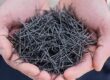
Structural macro fibers are synthetic fibers developed specifically for concrete reinforcement.
They are added to the concrete during mixing. As the concrete is mixed, the fibers spread throughout the entire concrete mass.
This creates a three-dimensional reinforcement system.
That is a major difference compared to steel mesh.
Steel mesh works mainly in one layer. Macro fibers are distributed through the full concrete cross-section.
That means they do not work only at the top or bottom of the slab. They work throughout the concrete.
When stress appears in the concrete, the fibers help:
- absorb tensile forces
- distribute loads
- limit crack formation
- control crack width
- improve the concrete’s behavior after cracking
This does not mean that fiber-reinforced concrete becomes indestructible.
But it does mean that the concrete behaves in a more controlled and more resistant way.
Another important advantage:
Macro fibers do not rust.
They are not affected by moisture in the same way as steel. They also do not need to be lifted, tied or positioned with spacers.
If they are correctly dosed and properly mixed, they are already where they need to be:
throughout the entire concrete slab.
For this type of application, ArmoTec structural macro fiber is designed to replace traditional steel mesh used as secondary reinforcement in many ground-supported concrete slabs.
When Is a Concrete Slab Without Steel Reinforcement Possible?
A concrete slab without steel reinforcement is mainly possible when it is a ground-supported slab and the reinforcement is mainly needed for:
- load distribution
- crack prevention
- crack control
Typical applications include:
- garage slabs
- driveways
- terraces
- walkways
- garden shed bases
- smaller workshop floors
- storage areas
- yard slabs
- agricultural concrete surfaces
- many types of ground-supported concrete floors
In these applications, a sufficient amount of structural macro fibers can take over the function of traditional steel mesh.
But the complete construction must be correct.
That means:
- the slab must be thick enough
- the concrete quality must be suitable
- the base layer must be compacted and stable
- the expected loads must be considered
- the fibers must be used in the correct dosage
- the concrete must be placed and cured properly
A thin, poorly prepared concrete slab will not become good just because fibers are added.
Macro fibers are a strong and practical reinforcement solution, but they do not replace good concrete practice.
When Should Steel Reinforcement Not Be Left Out?
There are concrete structures where steel reinforcement must not simply be replaced with macro fibers.
These include load-bearing structural elements such as:
- foundations
- suspended slabs
- beams
- columns
- walls
- stairs
- cantilever slabs
- retaining walls
- other statically designed structures
The same applies to structural foundation slabs for houses or larger buildings.
If a structural engineer or construction plan specifies a certain steel reinforcement, it must not be removed without proper approval.
This is especially important in cases involving:
- high loads
- difficult soil conditions
- large areas
- building foundations
- commercial or industrial structures
- permit-required construction
- statically calculated elements
The correct message is not:
“Steel is never needed.”
The correct message is:
In many ground-supported concrete slabs, traditional steel mesh used as secondary reinforcement can be replaced with structural macro fibers. But in load-bearing or statically designed structures, the decision must be checked professionally.
Steel Mesh or Macro Fiber – What Is the Practical Difference?
With steel mesh, reinforcement is installed as a prefabricated grid inside the concrete. It mainly works in the layer where it is placed.
For the mesh to work properly, it must:
- sit on spacers
- remain at the correct height
- be overlapped correctly
- be tied properly
- stay in position during pouring
With macro fibers, the process is different.
The fibers are mixed directly into the concrete. They spread through the full concrete cross-section and create a spatial, three-dimensional reinforcement.
This means there is no need for:
- cutting mesh
- carrying large steel sheets
- tying overlaps
- placing spacers
- lifting mesh during pouring
- worrying that the mesh has sunk too low
This saves time and makes the work easier.
For smaller construction sites, private concrete work or hard-to-access areas, this is a major advantage.
Transport is also much simpler. Steel mesh is large, heavy and difficult to move. Macro fibers are supplied in bags and are much easier to store and carry to the job site.
There is also the corrosion advantage.
Steel can rust. Macro fibers cannot.
Steel mesh is a traditional solution. But it is not always the most practical one.
Structural macro fibers are especially useful when a simple, fast and reliable reinforcement solution is needed for ground-supported concrete slabs.
The Right Concrete Thickness Is Still Essential
If you want to pour a slab without steel mesh, you should not think only about reinforcement.
Concrete thickness is just as important.
A walkway is not loaded the same way as a driveway. A terrace is different from a garage floor. A slab for a passenger car is not the same as a slab that will carry heavy machinery, vans or trucks.
The slab thickness must match the intended use.
If the concrete is too thin, the risk of problems increases:
- cracks
- edge breaks
- settlement damage
- surface failure
- reduced service life
Even a good fiber reinforcement cannot fully compensate for a slab that is too thin for its purpose.
The goal is always a complete, suitable system:
- stable base layer
- sufficient concrete thickness
- suitable concrete quality
- correct fiber dosage
- proper placement
- proper curing
The Base Layer Is as Important as the Concrete
Many slab failures do not happen because the concrete itself was poor.
They happen because the base layer was not prepared properly.
A concrete slab should not simply be poured onto loose soil.
The base must be:
- load-bearing
- even
- compacted
- stable
- suitable for the intended load
In many cases, a compacted gravel or crushed stone base layer is needed. This provides even support and helps transfer loads into the ground.
If the base moves, sinks or settles unevenly, the concrete slab may crack or drop.
Neither steel mesh nor macro fibers can fully fix a weak base layer.
That is why the base preparation is especially important when building a slab without steel mesh.
Macro fibers make reinforcement simpler.
But they do not replace a proper load-bearing base.
Correct Dosage Is Not a Small Detail
One of the most important points with macro fibers is dosage.
The fibers must be added in a sufficient amount.
A symbolic amount is not enough.
This is very important:
1 kg of macro fiber per cubic meter of concrete is generally not enough to replace steel mesh properly.
If you want to replace the function of steel mesh, the dosage must match the load and the application.
For lighter surfaces, a lower dosage may be enough.
For stronger applications such as:
- garages
- driveways
- workshop floors
- storage areas
- frequently used concrete slabs
a higher dosage is usually required.
For even heavier loads, the dosage must be adjusted or professionally checked.
The correct amount depends on:
- intended use
- concrete thickness
- expected load
- concrete quality
- slab size
- base layer
- required crack control
Saving money by using too little fiber is the wrong kind of saving.
Too little fiber cannot deliver the same performance as a properly designed macro fiber reinforcement.
When using ArmoTec structural macro fiber as an alternative to steel mesh, the dosage must always match the slab type, concrete thickness and expected load.
Common Mistakes With Fiber-Reinforced Concrete Slabs
One common mistake is treating macro fibers like a minor additive.
The thinking is:
“We’ll just throw a little fiber into the concrete, and it will be fine.”
That is not how it works.
Macro fibers are a reinforcement solution. They must be treated seriously.
That means the following points are essential:
- correct dosage
- even distribution
- sufficient mixing time
- proper concrete consistency
- proper placement
- proper curing
Another common mistake is using concrete that is too wet.
Too much water makes concrete easier to place, but it can reduce strength and durability. It can also increase shrinkage and the risk of cracking.
Poor curing is also a major problem.
Fresh concrete must be protected from drying too quickly. Sun, wind and heat can dry the surface too fast. This can create early cracks, even if the reinforcement itself was selected correctly.
The fiber is an important part of the solution.
But the entire concrete process must be done properly.
What Are the Advantages of a Slab With Macro Fibers?
A concrete slab reinforced with structural macro fibers can offer several practical advantages.
1. Easier installation
There is no need to transport, cut, place or tie steel mesh. The fibers are mixed directly into the concrete.
2. Three-dimensional reinforcement
Steel mesh works mainly in one layer. Macro fibers are distributed throughout the entire concrete slab.
3. No corrosion
Macro fibers do not rust. This is a major advantage for outdoor slabs, garages, farm areas, yards and damp environments.
4. Fewer placement errors
With steel mesh, performance depends heavily on whether the mesh is in the correct position. With macro fibers, this issue is greatly reduced if the concrete is mixed properly.
5. Easier logistics
Bags of macro fibers are easier to transport and store than large steel mesh sheets.
6. Faster work on site
Less preparation, less handling and fewer installation steps mean a faster and cleaner workflow.
For many homeowners, contractors and small construction teams, this means:
less heavy manual work, fewer complications and faster concreting.
Typical Applications for Concrete Slabs Without Steel Mesh
Macro fiber reinforcement can be useful in many everyday concrete projects.
Good examples include:
- garage floors
- driveways
- terraces
- garden shed bases
- walkways
- yard slabs
- smaller workshop floors
- storage areas
- agricultural concrete surfaces
- ground-supported indoor concrete floors
For a garage slab, fibers help distribute vehicle loads and control cracks.
For a driveway, they can improve the slab’s resistance to repeated vehicle loading.
For a terrace, they help reduce cracking caused by shrinkage and temperature changes.
For garden sheds, workshops and storage areas, they can make the slab easier to build without the extra work of steel mesh.
But the application must always match the construction.
A light pedestrian surface is different from a slab carrying heavy machinery.
Is a Slab Without Steel Mesh Cheaper?
In many cases, a slab with macro fibers can be more cost-effective than a traditional slab with steel mesh.
But the calculation is not only about the price of materials.
Steel mesh also creates additional work:
- transport
- storage
- cutting
- placing
- overlapping
- tying
- using spacers
- checking mesh position
All of this takes time and labor.
Macro fibers simplify the process. They are mixed into the concrete and then distributed throughout the slab.
This can make the work faster and less complicated.
Of course, the economy of the solution depends on the specific project.
The correct fiber dosage must still be used.
Using too little fiber is not smart saving. It creates a weaker solution.
But when used correctly, structural macro fibers can be a very economical alternative to traditional steel mesh.
Do You Still Need Joints or Saw Cuts With Fiber Concrete?
Yes, in many cases joints or saw cuts are still needed.
Macro fibers help control cracking, but they do not remove the basic rules of concrete work.
Concrete shrinks as it hardens. It also expands and contracts with temperature changes.
That is why larger slabs must be divided in a controlled way.
Joints help release stress in planned locations instead of allowing random cracks to appear.
The joint layout depends on:
- slab size
- slab shape
- concrete thickness
- expected load
- local conditions
- indoor or outdoor use
Macro fibers improve crack control.
But good joint planning is still important.
When Should You Involve a Professional?
A professional or structural engineer should be involved whenever the slab has a structural role or high loads are expected.
This applies to:
- house foundations
- large garages
- commercial floors
- difficult ground conditions
- high point loads
- machine foundations
- statically designed structures
- projects with construction permits
- situations where the plan already specifies steel reinforcement
If there is uncertainty, professional checking is the right choice.
For simple ground-supported slabs around a house, a macro fiber solution can be very suitable.
But for load-bearing structural elements, the decision should not be guessed.
It should be checked.
Beton Booster: Concrete More Simply and More Cost-Effectively
If you want to pour a ground-supported concrete slab and replace traditional steel mesh used as secondary reinforcement, structural macro fibers can be a strong solution.
They can take over the key functions of steel mesh in suitable applications:
- load distribution
- crack prevention
- crack control
At the same time, they make the work easier:
- no heavy steel mesh
- no cutting
- no tying
- no mesh sinking to the bottom
- no corrosion
- easier transport
- faster installation
The key is correct dosage.
A small symbolic amount is not enough if the goal is to replace the function of steel mesh.
If you want to concrete more simply and more cost-effectively, visit BetonBooster.com and learn more about structural macro fibers for your concrete slab.
With ArmoTec structural macro fiber, you can simplify many concrete slab projects by replacing traditional steel mesh used as secondary reinforcement.
Conclusion: Possible Without Steel Reinforcement – But Not Always
A concrete slab without steel reinforcement is possible when the conditions are right.
This is especially true for ground-supported concrete slabs where steel mesh is mainly used for:
- load distribution
- crack prevention
- crack control
These functions can be taken over by structural macro fibers when the dosage is correct.
But this does not mean that steel reinforcement can be removed from every concrete structure.
For load-bearing elements, structural foundation slabs or special constructions, the decision must be made by a professional.
The best result comes from a complete system:
- load-bearing base layer
- suitable concrete thickness
- correct concrete quality
- proper installation
- sensible joint planning
- sufficient macro fiber dosage
When all these points are handled properly, a concrete slab without traditional steel mesh can be not only possible, but also simpler, faster and more economical.
Frequently Asked Questions About Concrete Slabs Without Steel Reinforcement
Can you pour a concrete slab without steel mesh?
Yes, in many ground-supported concrete slabs this is possible. The slab must be suitable for the expected load, and a sufficient amount of structural macro fibers must be used.
When can macro fibers replace steel reinforcement?
Macro fibers can replace steel reinforcement mainly when the steel mesh is used as secondary reinforcement. That means for load distribution and crack control.
Is a slab without steel reinforcement strong enough?
It depends on the application. A properly designed and correctly dosed macro fiber reinforcement can be sufficient for many ground-supported slabs. For structural elements, the design must be checked.
Is 1 kg of macro fiber per cubic meter enough?
For a real steel mesh replacement, 1 kg per cubic meter is generally not enough. The dosage must match the load, concrete thickness and intended use.
Can a garage slab be built without steel mesh?
Yes, in many garage slabs a correctly dosed macro fiber reinforcement can be a practical alternative to steel mesh. A stable base layer, sufficient concrete thickness and the right fiber dosage are essential.
Do macro fibers rust in concrete?
No. Synthetic structural macro fibers do not rust. This is a major advantage compared to steel, especially in outdoor or damp areas.
Do you still need joints with fiber-reinforced concrete?
In many cases, yes. Macro fibers help control cracks, but they do not automatically replace proper joint planning.
When should a structural engineer be consulted?
A structural engineer should be consulted for load-bearing elements, building foundations, high loads, difficult ground conditions or statically designed structures.