
Many people think that concrete can withstand almost anything on its own.
It is strong, dense and solid. That is true, but only partly. Concrete has very high compressive strength. That is why it is used for foundations, floor slabs, walkways, driveways, industrial floors and many other structures.
But concrete has one weakness.
Concrete is much more sensitive to tensile forces, bending stress, shrinkage, temperature movement and cracking. That is exactly why concrete is often reinforced in some way.
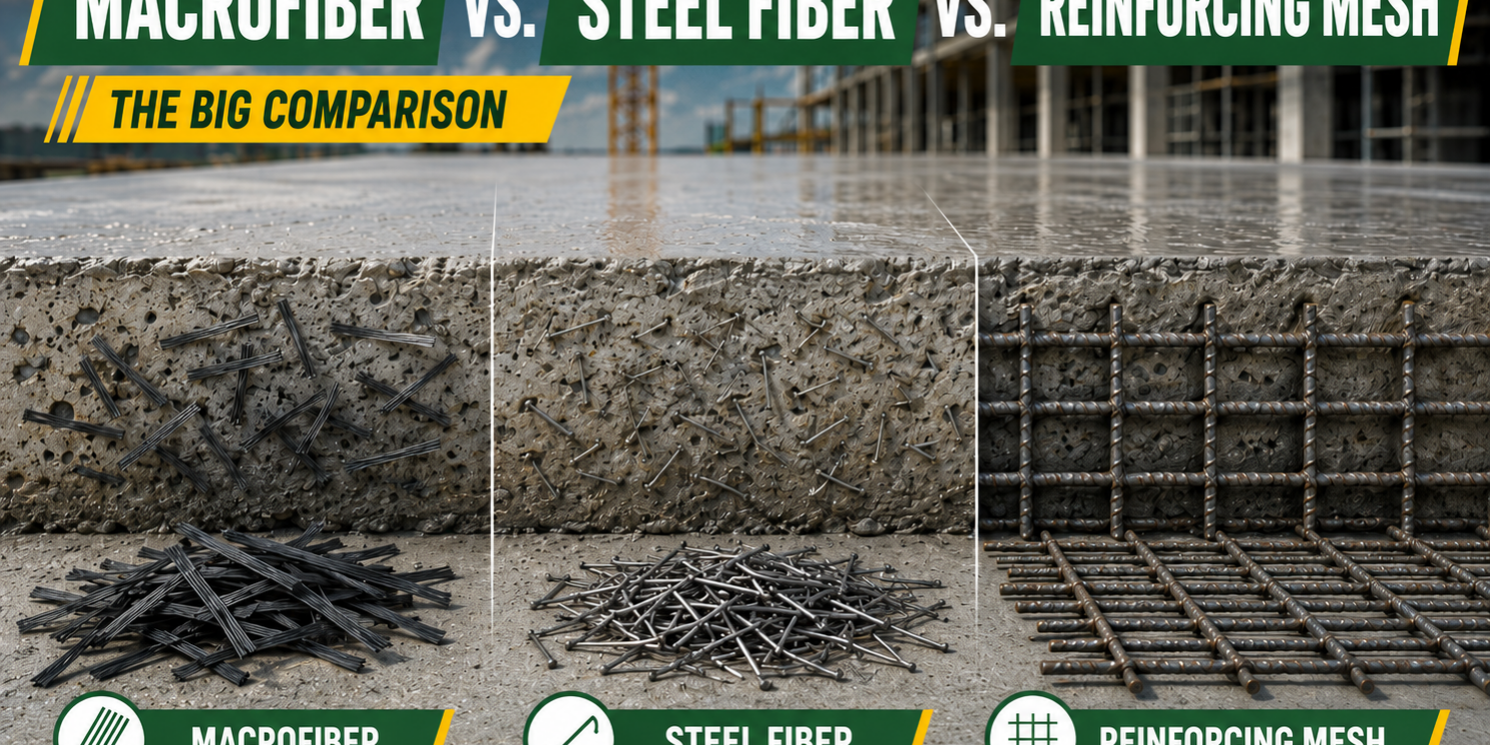
There are several ways to do this. The best-known solution is steel reinforcing mesh. Steel fibers are also used, especially in industrial applications. In recent years, structural macrofibers have become increasingly common as a modern, corrosion-free alternative for many concrete jobs.
So the question is not which solution is “the best” for everything.
The real question is:
Which concrete reinforcement solution is suitable for what, where are its strengths, where are its limits, and which one is the most sensible choice for a given concrete application?
That is what we will go through in this article in a clear and practical way.
Why does concrete need reinforcement at all?
Concrete handles compressive loads very well. This means that when concrete is loaded from above, for example by a car, a machine or the weight of a building, it can absorb large forces.
The problem starts when tensile or bending stress develops inside the concrete.
These stresses can appear for several reasons:
concrete shrinks while it sets,
concrete expands and contracts as temperatures change,
the ground underneath can move or settle slightly,
the surface can receive point loads or repeated loads,
the concrete does not always dry evenly.
These effects lead to cracks.
A crack is not always a serious structural failure by itself. However, untreated cracks can cause major problems later. Water, frost, salt, dirt and other aggressive substances can enter through them. This weakens the concrete, reduces its service life and, in the case of steel reinforcement, starts corrosion.
So the goal of concrete reinforcement is not to make every movement of concrete impossible. That would be unrealistic.
The goal is to limit the formation and opening of cracks, distribute loads more effectively and keep the concrete usable for a longer time.
Reinforcing mesh: the traditional solution
Steel reinforcing mesh is the best-known form of concrete reinforcement.
It has been used for decades, professionals know it well, and in many structures it is still indispensable. In slabs, beams, walls, columns and serious load-bearing structures, reinforcing steel still plays a fundamental role.
The advantage of reinforcing mesh is that it can absorb high tensile forces. This is exactly how reinforced concrete works: the concrete takes the compressive forces, while the steel takes the tensile forces.
That is why the topic should not be reduced to “mesh is bad” or “mesh is outdated”. That is not true.
Reinforcing mesh is a very important solution, and it works well in many areas.
The problem is rather that, in smaller and medium-sized concrete jobs on the ground, it brings many possibilities for execution errors.
The mesh has to be transported, moved, cut, laid with overlaps, tied together and held at the correct height with spacers. On paper, this sounds simple. In real life, it often looks different.
A common mistake is that the mesh ends up at the bottom of the concrete. For example, with underfloor heating, the heating pipes are often tied to the mesh, and then the concrete is poured over it. In this case, the mesh remains in the lower part of the cross-section, and its crack-control effect becomes much weaker.
The mesh only works well when it is in the right place.
This sentence is very important.
Reinforcing mesh is not effective simply because it is “inside the concrete”. It is effective when it is installed in the correct position, with the correct concrete cover, the correct overlap and proper fixing.
For ground-supported slabs, walkways, terraces, garage floors or driveways, simple execution matters a lot. In these cases, mesh is often cumbersome, labor-intensive and frequently placed inaccurately.
Another major disadvantage of reinforcing mesh is corrosion.
Proper concrete cover protects the steel. However, when cracks, moisture, salt, frost or aggressive environments are present, water and oxygen can reach the steel. Then rust begins. Rust has a larger volume than steel, so it pushes against the concrete from the inside and causes further cracks and spalling.
This risk is especially important for outdoor concrete, agricultural environments, livestock facilities, salt-exposed surfaces and wet environments.
In summary: reinforcing mesh is a proven and important solution, but it is not the most practical choice for every concrete job. In ground-supported concrete slabs, it often brings a lot of work, many possible errors and a corrosion risk.
Steel fiber: a strong industrial solution with compromises
Steel fiber reinforced concrete follows a different logic.
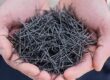
Here, no large steel element, mesh or bar is placed into the concrete. Instead, many small steel fibers are mixed into it. These fibers spread through the entire concrete volume and help bridge cracks from several directions.
This is a major difference compared to mesh.
Reinforcing mesh works in one plane. Steel fiber, on the other hand, works three-dimensionally, throughout the full concrete cross-section. This makes it especially useful for industrial floors, larger concrete surfaces and certain high-load applications.
The advantages of steel fiber are clear.
It improves the behavior of concrete after cracking. It helps prevent cracks from opening quickly. It provides better load distribution than poorly placed mesh. It reduces part of the traditional reinforcement work and, with proper design, delivers serious technical performance.
That is why steel fiber has long been known in the world of industrial floors.
Still, it is not ideal in every situation.
One of the biggest disadvantages of steel fiber is that it is still made of steel. This means it is prone to corrosion. Fiber ends near the concrete surface can rust in particular. This creates an aesthetic problem, but in some environments it can also become a question of usability and durability.
Fiber ends appearing on the surface can cause problems for another reason as well.
On barefoot areas, in livestock facilities, around homes or on decorative concrete surfaces, tiny steel fiber ends can be unpleasant, dangerous or simply unacceptable. With abrasion, grinding or intensive use, this problem becomes even more noticeable.
Steel fiber is not always comfortable to handle either. The bags can be heavy, the fibers can be sharp, mixing requires attention, and placement requires experience.
That is why steel fiber is technically a strong solution, but not always practical for residential or smaller concrete jobs.
Put more simply: steel fiber is a good industrial tool, but not always the most user-friendly solution for everyday concreting.
Structural macrofiber: a modern, corrosion-free alternative
Structural macrofiber is a modern form of fiber reinforcement.
Here, steel fiber is not added to the concrete. Instead, a polymer macrofiber specifically developed for concrete reinforcement is used. It should not be confused with ordinary “plastic”, and it is not simply shredded plastic waste.
A structural macrofiber is a technical product.
Its job is to distribute throughout the concrete volume and help with crack control, load distribution and improved durability.
One of the biggest advantages of macrofiber is three-dimensional reinforcement.
The fibers do not lie in a single plane like reinforcing mesh. They are present throughout the entire concrete cross-section. This means they are present in every direction inside the concrete. When cracks form, the fibers bridge the two sides of the crack and help prevent the crack from opening further.
The second major advantage is corrosion resistance.
Polymer macrofibers do not rust. Steel corrosion does not start, they do not push the concrete apart from the inside, and rust stains do not appear on the surface.
This is especially important for outdoor concrete, wet environments, agriculture, livestock facilities, driveways, walkways, terraces and places where concrete comes into contact with water, salt or aggressive substances.
Macrofiber is also simpler from an execution point of view.
No transport of large mesh sheets.
No cutting of reinforcing mesh.
No tying.
No spacers.
No issue with mesh sinking to the bottom of the concrete.
Macrofiber must be dosed into the concrete and then mixed thoroughly. This is a different type of work from traditional mesh reinforcement. Instead of physical reinforcement work, the focus shifts to accurate dosing and thorough mixing.
For many concrete jobs, this is a huge advantage.
Especially when a smaller team is working, space is limited, the job has to move quickly, or nobody wants to struggle with large reinforcing mesh sheets.
Still, the limits must be stated clearly.
Structural macrofiber is not a miracle material. It does not repair poor concrete, it does not replace a poorly prepared base, and it does not replace reinforcing steel in every structure.
For ground-supported concrete slabs, it is often a very good alternative to reinforcing mesh. Examples include walkways, terraces, garage floors, driveways, screeds, slab-like concrete works or agricultural concrete surfaces.
For elevated slabs, beams, columns, walls and other load-bearing structures, structural design and traditional reinforcement are still required.
So macrofiber does not replace everything.
However, in many concrete jobs where reinforcing mesh has been used out of habit, it offers a simpler, faster and corrosion-free solution.
The key difference: plane reinforcement or three-dimensional reinforcement
One of the biggest differences between the three solutions is where and how they work inside the concrete.
Reinforcing mesh is plane reinforcement.
This means the mesh is placed at a certain height within the concrete cross-section. It works well when it is installed in the right zone. In the wrong position, its effectiveness drops significantly.
That is why spacers, correct concrete cover and accurate execution are so important.
Fiber reinforcement, on the other hand, works three-dimensionally.
Steel fibers and macrofibers distribute through the entire concrete volume. They do not work in one plane, but at many small points in several directions. When a crack starts, fibers are in the path of the crack and take on a bridging role.
In practice, this means fiber reinforcement is less sensitive to the mistake of being placed “in the wrong position” in the concrete.
Of course, proper mixing is still important. If the fibers clump together, the dosage is wrong or placement is poor, fiber reinforced concrete will not work properly either.
Still, the difference is essential:
Mesh works well when it is exactly in the right place. The advantage of fiber reinforcement is that it is present throughout the full concrete cross-section.
That is why macrofiber often gives a practical advantage in smaller and medium-sized ground-supported concrete jobs.
Execution comparison
When choosing concrete reinforcement, technical performance is not the only thing that matters.
Execution on site is just as important.
A solution can be strong on paper, but difficult, slow or error-prone on site. With reinforcing mesh, this is a common problem.
The mesh has to be transported to the site. We are talking about large sheets that are difficult to move, cut and place accurately. The joints must overlap. Spacers must be used correctly. The mesh must not be stepped down during concreting.
In reality, this often happens.
Workers step on it, the mesh sinks, spacers move, or they are not used correctly in the first place. In the end, the mesh is indeed “inside the concrete”, but not where it needs to be in order to work.
Steel fibers and macrofibers behave differently.
There is no mesh laying. The fibers are added to the concrete and mixed evenly. This means less physical work on site, but mixing quality becomes essential.
Macrofiber is especially favorable in this respect for smaller and medium-sized concrete jobs. It comes in manageable packaging, is easy to dose, does not prick like steel fiber, does not rust and does not require heavy mesh installation work.
The execution difference can be summed up like this:
With reinforcing mesh, much of the work is preparation and installation.
With steel fibers and macrofibers, the work shifts to dosing and mixing.
That is why macrofiber is often a faster, simpler and more predictable solution.
Durability and corrosion
The durability of concrete is not determined only by how strong it is on the first day.
It also matters what happens to it years later.
Outdoors, concrete gets wet, can freeze, can come into contact with salt, faces temperature changes and receives mechanical loads. In agriculture, additional stress appears: slurry, feed residues, animal urine, cleaning agents, acidic and alkaline effects.
In such environments, corrosion is a key issue.
Reinforcing mesh and steel fibers are both made of steel. With proper concrete cover, the steel is protected. The problem begins when cracks, surface wear, moisture or aggressive environments weaken this protection.
Then rust begins.
Rusting steel creates internal pressure in the concrete. Cracks grow, the surface can spall, and the durability of the structure decreases.
Macrofiber, on the other hand, does not rust.
This is a simple but very important difference.
Polymer macrofiber does not create internal rust pressure. Rust stains do not appear on the concrete surface. In wet or corrosion-prone environments, this is a clear advantage.
This does not mean that macrofiber reinforced concrete lasts forever.
Concrete quality, the water-cement ratio, curing, the base, compaction and surface protection remain decisive. Macrofiber does not replace good concrete technology.
But from the point of view of corrosion, it has a clear advantage: there is no rusting steel reinforcement in the concrete.
Crack control: how do the three solutions work?
Cracks in concrete cannot be completely eliminated.
The goal of good concreting is rather to reduce the formation of cracks, limit crack opening and preserve the long-term usability of the concrete.
Reinforcing mesh limits crack opening when it is in the right position. The crack reaches the plane of the mesh, the steel takes part of the tensile force and helps hold the concrete together.
Steel fibers work at many small points. The fibers distributed throughout the concrete bridge cracks and improve the concrete’s behavior after cracking.
Macrofiber works on a similar principle, but it is made from corrosion-free polymer material. The fibers distributed in the concrete help limit further crack opening.
The most important difference here is also the place of action.
Mesh works in one plane.
Fibers are present throughout the full cross-section.
That is why fiber reinforcement is especially useful for shrinkage cracks, stresses caused by temperature movement and crack risks in ground-supported slabs.
So macrofiber does not “remove” the natural movement of concrete.
Its job is to keep cracks under control.
Price and total cost: it is not only the material price that matters
Many people compare the solutions by looking only at the material price.
This is understandable, but misleading.
The square meter price of reinforcing mesh often looks favorable on paper. But the total cost does not consist only of the material price.
Transport, unloading, cutting, overlaps, tying, spacers, labor time, helper labor and the risk of execution errors must also be considered.
Moving a large mesh sheet is not always easy. On smaller sites, in narrow yards, during residential work or when working with a small team, it becomes especially inconvenient.
With steel fibers and macrofibers, the cost appears differently.
No mesh transport.
No cutting.
No tying.
No spacers.
No separate mesh installation work.
The fiber is added to the concrete and mixed in.
Because of this, macrofiber is often not only simpler, but also favorable in terms of total execution cost. Especially when labor time, speed and avoiding mistakes also matter.
So the right question is not: “Which material is cheaper per kilogram or per square meter?”
The better question is:
Which solution gives the best final result when the total execution cost is taken into account?
Which solution is suitable for what?
For a good decision, it is not enough to speak generally about the three solutions.
Let’s look at practical examples.
Garden walkway
For a garden walkway, structural macrofiber is a very good choice. It is easy to dose, distributes throughout the entire concrete and helps control shrinkage cracks and service cracks.
Reinforcing mesh is often too cumbersome here. It can easily end up in the wrong position, and the amount of work is often out of proportion to the task.
Terrace
For a terrace, crack control and durability are also important. Since it is an outdoor surface, corrosion resistance is a major advantage.
Macrofiber can be a good solution here, especially with a properly prepared base, good concrete quality and careful curing.
Garage floor
For a garage floor, higher loads must be considered. A car stands on it, wheel loads affect the surface, and the use is repeated over time.
Macrofiber can also be a good choice here with the right dosage. For heavier loads or special structural situations, structural design is required.
Driveway
For a driveway, two things are essential.
The first is the proper base. Without a compacted subgrade, a stable load-bearing layer and a well-prepared foundation, even the best reinforcement will not deliver a good result.
The second is proper reinforcement of the concrete.
Here, macrofiber is often a simpler and more modern alternative to reinforcing mesh. It does not rust, it does not need to be cut and positioned, and it works throughout the full cross-section.
Industrial floor
For an industrial floor, the decision is a design question.
Macrofiber, steel fiber and traditional reinforcement can all be possible. The choice depends on the load, the size of the floor, joint layout, machine traffic and technical requirements.
Here, it is not worth deciding out of habit. A designed solution is needed.
Elevated slab, beam, column, wall
In these structures, macrofiber is not a general replacement for reinforcing steel.
In elevated slabs, beams, columns and walls, reinforcing steel has a structural role. These require structural design, and the reinforcement must be determined according to the loads.
Macrofiber can play a supplementary role in such cases, but it does not automatically replace reinforcing steel.
Agricultural concrete surfaces
In barns, livestock facilities, around slurry storage areas and on agricultural concrete surfaces, durability is especially important.
Moisture, contamination, acidic and alkaline effects and mechanical stress are common here.
Macrofiber has the advantage that it does not rust, helps with crack control and makes execution simpler. However, the chemical resistance of concrete is not determined by the fiber alone. The concrete mix, density, water-cement ratio, curing and surface protection remain decisive.
Quick comparison table
| Criterion | Reinforcing mesh | Steel fiber | Structural macrofiber |
|---|---|---|---|
| Working principle | Reinforces in one plane | Works throughout the full cross-section | Works throughout the full cross-section |
| Execution | Cutting, tying and spacers are needed | Mixed into the concrete | Mixed into the concrete |
| Corrosion | Can rust | Can rust | Does not rust |
| Crack control | Effective in the correct position | Good crack bridging | Good crack bridging |
| Error risk | High, mainly due to wrong position | Mixing errors are possible | Mixing errors are possible |
| Residential use | Often cumbersome | Less convenient | Simple and practical |
| Industrial use | Good depending on design | Often used | Good depending on design |
| Surface issue | No fiber ends | Steel fiber ends can appear | No sharp steel fiber ends |
| Transport | Large, heavy sheets | Bagged or boxed material | Easy-to-handle packaging |
| Labor time | Higher | Can be lower | Can be lower |
| Limitation | Correct position and concrete cover are needed | Corrosion and fiber ends | Does not replace all structural reinforcement |
| Best use | Load-bearing reinforced concrete structures | Industrial floors, designed surfaces | Ground-supported slabs, residential and outdoor concrete surfaces |
Common misconceptions
“Macrofiber is just plastic, so it is weak.”
This statement is misleading.
Structural macrofiber is not simple plastic waste. It is a technical fiber developed for concrete reinforcement. Its job is not to behave like a steel bar. Its job is to distribute throughout the concrete and help bridge and limit cracks.
Its performance should not be judged by the fact that it is “made of plastic”, but by the residual tensile strength, crack-bridging ability and durability advantages it provides in concrete.
“Reinforcing mesh is always stronger.”
It is not that simple.
Reinforcing mesh is made from strong material, but it only works well when it is in the right place. In the wrong position, at the bottom of the concrete or without proper concrete cover, its effectiveness decreases significantly.
For ground-supported slabs, the key question is often not whether the mesh is strong as a material. The real question is whether, after execution, it is actually where it needs to be in order to work.
“Steel fiber is better because it is made of steel.”
Steel is a strong material, but it is not an advantage in every environment.
Steel fibers can rust, fiber ends on the surface can cause problems, and handling is not always convenient. In industrial floors, steel fiber is often a good solution. In residential or corrosion-prone environments, however, it is not always the most practical choice.
“Macrofiber replaces reinforcing steel everywhere.”
No.
This is an important limitation.
Structural macrofiber can be an excellent alternative to reinforcing mesh in many ground-supported concrete slabs. However, it is not a general replacement for reinforcing steel in elevated slabs, beams, columns, walls and other load-bearing structures.
For these, structural design is required.
“With fiber reinforced concrete, you do not need a good base.”
This is also false.
Macrofiber helps a lot with crack control, but it does not replace a poor base. For a driveway, garage or terrace, a compacted subgrade, the right layer structure and good concrete quality remain essential.
Macrofiber makes good concreting stronger and more durable. It does not automatically turn poor concreting into good concreting.
Beton Booster recommendation: when should you choose ArmoTec macrofiber?
ArmoTec structural macrofiber is a good choice when you are making a ground-supported concrete slab and want simpler, faster and corrosion-free reinforcement.
It is especially recommended for the following applications:
walkway,
terrace,
garage floor,
driveway,
screed,
slab-like concrete works,
garden concrete surfaces,
agricultural concrete surfaces,
smaller industrial or workshop floors.
The advantage of ArmoTec is that the fiber distributes throughout the entire concrete cross-section. No mesh needs to be cut, moved, tied or positioned with spacers. It does not sink to the bottom of the concrete like incorrectly installed mesh. It does not rust, so it provides a major advantage outdoors and in wet environments.
For a good result, of course, proper concrete quality, accurate dosage, thorough mixing, a good base and careful curing are still necessary.
ArmoTec is not a miracle product. It does not promise perfect concrete with less care.
It makes concrete reinforcement simpler, faster and more predictable.
You can easily calculate the required amount with the Beton Booster calculator.
Conclusion: not every concrete job needs the same solution
Reinforcing mesh remains an important and, in many areas, indispensable solution. In load-bearing reinforced concrete structures, elevated slabs, beams, columns and walls, its role is central.
Steel fiber is a strong solution proven in industrial environments. For larger floors and designed industrial surfaces, it delivers high technical performance, but it comes with corrosion and surface-related compromises.
Structural macrofiber is a modern, corrosion-free alternative that is simpler and more practical for many ground-supported concrete jobs. It is especially strong for walkways, terraces, garage floors, driveways and agricultural concrete surfaces.
A good decision does not come from habit.
A good decision comes from understanding what kind of concrete is being made, what load it will receive, what environment it must work in and which reinforcement best supports long-term durability.
In short:
Reinforcing mesh remains important as structural reinforcement.
Steel fiber is strong, but not practical everywhere.
Structural macrofiber provides a simpler, faster and corrosion-free solution for many ground-supported concrete slabs.