
You are standing where your new driveway will go, and you have two options: steel mesh or macro fibre. You know the mesh. About the fibre, you hear: “It’s bound to be more expensive, it’s just in fashion.”
You don’t have to believe that, and you don’t have to believe the opposite either. You can work it out.
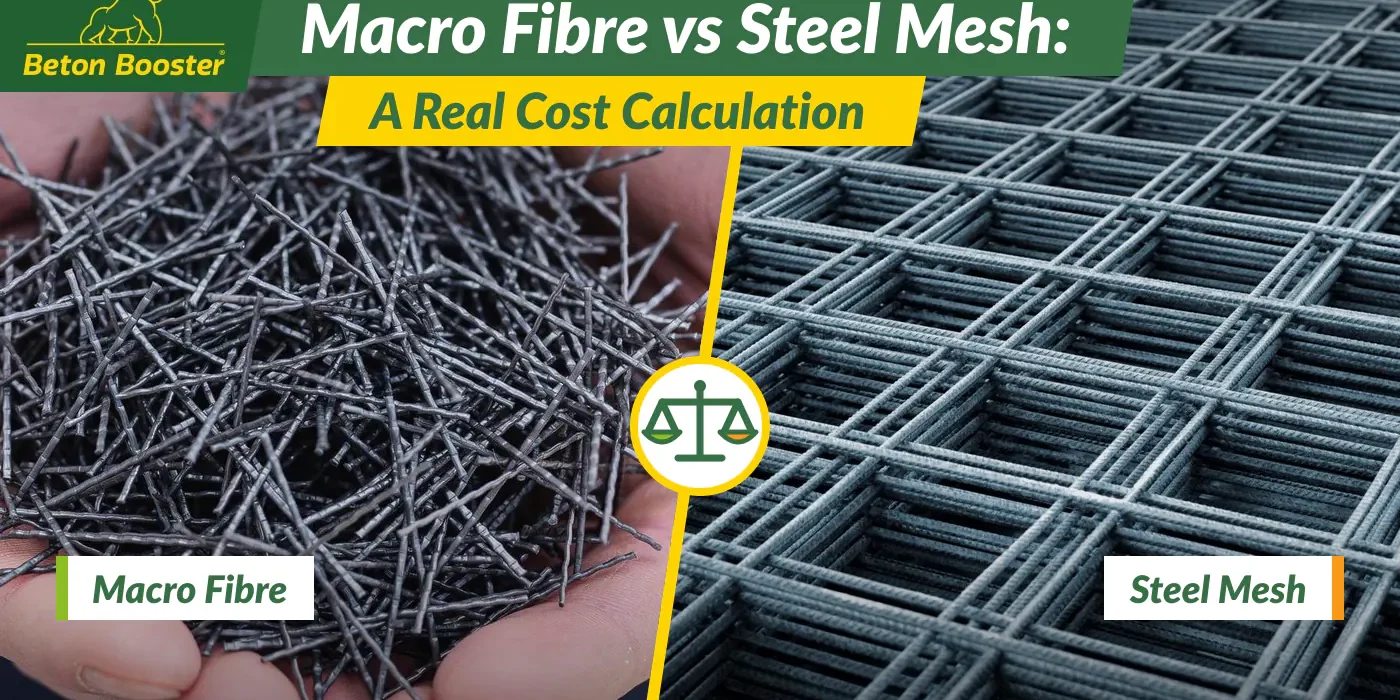
In short: for a 100 m², 10 cm thick driveway you need 40 kg of ArmoTec, which costs €399.60 including VAT, with free delivery. With Q188A steel mesh you need 8 sheets for €533.92 including VAT, plus delivery and installation labour. How big the difference is in your case depends on your own quotes. For load-bearing structures, the structural engineer decides on the reinforcement.
Below you will find two worked examples with German and Austrian prices, each with its source and date. At the end there is a blank table for your own figures.
What belongs in an honest cost calculation?
Most comparisons go wrong because they only look at the price per kilo: this much for the fibre, that much for the mesh, done. But the bill has more lines than that, and the mesh side has more of them.
If you use steel mesh, count these costs:
- Material. The price of the sheets. You buy whole sheets and pay for the offcuts too.
- Delivery. A 6 m sheet won’t fit in the boot of your car. You need a lorry or the supplier’s delivery.
- Small-quantity surcharge. Some suppliers charge an extra fee per delivery for orders under one tonne.
- Cutting and laps. The sheets have to be cut to size and overlapped at the edges. The lap is material you pay for, but it adds no area.
- Spacers and tie wire. The mesh must not lie on the ground. It has to be lifted and held in place while you pour.
- Labour. Someone has to unload it, carry it over, cut it, lay it and tie it.
- Risk of mistakes. If the mesh gets pushed down during the pour or ends up at the wrong height, it doesn’t work where it should. Once the concrete is poured, you can’t fix that.
With macro fibre the list is shorter: the price of the fibre, its delivery and the dosing. The fibre goes into the mix, and there is no separate installation.
That doesn’t mean fibre is always cheaper. It only means that the price per kilo is just the first line of the bill.
The numbers: what do steel mesh and ArmoTec cost today?
We collected the prices on 12 November 2026. Prices change, so we have given the source and date for each one.
| Item | Price | Source, date |
|---|---|---|
| ArmoTec 40 mm structural macro fibre, 1 kg | €9.99/kg incl. VAT; delivery €10, free from 12 kg | betonbooster.com, ArmoTec product page, 12 Nov 2026; VAT and delivery: Beton Booster, 12 Nov 2026 |
| Q188A steel mesh, 6.00 × 2.30 m (13.80 m², 41.7 kg/sheet) | €66.74/sheet incl. VAT, i.e. €4.84/m² | Kuhn Bauzentrum online shop (Germany), 12 Nov 2026, incl. VAT; according to the page, the price is set on the day of order for the delivery date, and delivery is only within the Mainfranken region; sheet data: Kuhn product page and Kleiner price list |
| Delivery (mesh) by the supplier’s lorry | €90/load incl. VAT within 25 km, €100/load from 25.1 to 60 km | Kuhn Bauzentrum, delivery options, 12 Nov 2026 |
| Baustahlmatte AQ60 mesh, 230 × 100 cm (Austria) | €26.49/sheet incl. VAT, i.e. €11.52/m² | hornbach.at, product page, 12 Nov 2026 |
| Small-quantity surcharge under 1 tonne (another supplier) | €50 per delivery (trade price list, VAT not stated) | Konrad Kleiner GmbH, surcharges and conditions for reinforcing steel, 06/2025 |
| Flat delivery charge (mesh, another supplier) | €140 per delivery, without unloading help (trade price list, VAT not stated) | Konrad Kleiner GmbH, same document, 06/2025 |
| Collectively agreed wage, skilled worker, Germany (wage group 3) | €23.97/hour from 1 April 2026 | German construction industry wage table (IG BAU / ZDB / HDB), 2026 |
| Collectively agreed wage, skilled worker, Austria (Facharbeiter a)) | €21.96/hour from 1 May 2026 | WKO, construction wage table 2026 |
Three things before you start calculating.
Net or gross? Both the ArmoTec price and the mesh price above include VAT. If you get a net quote as a business, calculate the other side net as well, otherwise you are comparing apples with oranges.
A wage is not an hourly rate. The table shows the worker’s wage. The hourly rate a contractor charges is higher, because it also covers overheads and profit. If you work with a contractor, use their hourly rate.
Small sheets cost more. The sheet from the Austrian DIY store is smaller and a different type of mesh, so it can’t be compared one-to-one with Q188A. But it shows clearly that the price per square metre for small sheets can be more than double what you pay for 6 m sheets at a builders’ merchant.
You can check how big and how heavy each type of mesh is in our steel mesh weight table.
How to calculate the amount of fibre
The formula is simple:
ArmoTec (kg) = area (m²) × thickness (m) × dosage (kg/m³), rounded up to whole packs at the end.
In practice, concrete is ordered with an allowance, because some volume is lost during compaction. The fibre goes into the whole quantity ordered, so use the ordered m³ in your own calculation. The examples below are calculated without an allowance, just as we did not include the laps on the mesh side.
The dosage depends on thickness and load. Some values from the Beton Booster dosage table:
| Use | 5 cm | 10 cm | 15 cm | 20 cm |
|---|---|---|---|---|
| Driveway, carport | – | 3.8 kg/m³ | 3.2 kg/m³ | 2.6 kg/m³ |
| Garage floor | 4.5 kg/m³ | 3.8 kg/m³ | 3.2 kg/m³ | – |
| Footpath | – | 2.5 kg/m³ | 2.1 kg/m³ | – |
For industrial floors, the Beton Booster dosage guide gives 5-6 kg/m³, or a value based on the individual technical design. In that case, the structural engineer sets the exact figure.
You will find the step-by-step calculation in our article on calculating the ArmoTec dosage. If you would rather not do the maths, the ArmoTec calculator will do it for you; to use it, you enter your first name and email address.
One sentence from our product page belongs next to every calculation: “No macrofiber is superior enough to replace rebar mesh with a 1-2 kg dosage.” If someone arrives at a cheap total by using a very low dosage, that is not a saving but a risk.
Worked example 1: a 100 m² driveway
Let’s take a 100 m², 10 cm thick driveway and work through both sides the way they appear on the bill: material, delivery, surcharge, installation. For the comparison we use one layer of Q188A mesh, in whole sheets. Which mesh or which dosage your slab needs depends on the load and the ground.
| Q188A steel mesh | ArmoTec | |
|---|---|---|
| Quantity | 100 m² / 13.8 m² = 7.25 → 8 sheets (without laps), 333.6 kg | 100 m² × 0.10 m = 10 m³ concrete × 4 kg/m³ = 40 kg, 40 packs |
| Material | 8 × €66.74 = €533.92 incl. VAT | 40 × €9.99 = €399.60 incl. VAT |
| Delivery | €90 incl. VAT, by the supplier’s own lorry within 25 km (€100 up to 60 km) | free (from 12 kg) |
| Small-quantity surcharge | not stated by this supplier; some suppliers charge €50 per delivery under 1 tonne | none |
| Spacers, tie wire | no sourced price, enter the amount from your own quote | none |
| Unloading, cutting, tying, fitting spacers | as per the contractor’s quote | none, the fibre goes into the mix: €0 |
| Total | €623.92 + installation labour | €399.60 |
The price of the concrete is not included on either side. If the batching plant adds the fibre, ask whether they charge extra for it, and add that to the fibre side.
The mesh and delivery prices include VAT, under the supplier’s terms for private customers. If you buy as a business and get net prices, calculate the fibre side net as well.
Why 4 kg/m³? The Beton Booster dosage guide gives 4 kg/m³ for driveways and garages. The dosage table above gives 3.8 kg/m³ for 10 cm: that would come to 38 kg and €379.62. If you order the concrete with a 10% allowance, you need 44 kg of fibre for 11 m³, which is €439.56.
What does this table show?
In this example, the fibre comes out €224.32 cheaper on the total bill, or €184.36 with the allowance. And that is before the labour for installing the mesh. The fibre is cheaper on material too: if you can use the mesh offcuts elsewhere, the mesh costs 100 × €4.84 = €484.00, which is still more than the fibre.
40 kg of ArmoTec fits in the boot of your car. For 333.6 kg of 6 m long sheets, you need a lorry.
Better to spend that money on yourself.
But don’t forget one thing: this is an example, not a promise. If your supplier delivers for less, or you unload and tie the mesh yourself, the difference gets smaller. That is why there is a blank table at the end of this article. We describe step by step how to pour a carport or driveway slab yourself in this article.
Worked example 2: a 100 m² warehouse floor
Example 1 showed the whole bill. Here we look at how much the result depends on the structural engineer’s decision. This example shows the method, it is not a quote: for industrial floors, the structural engineer designs both the mesh and the fibre dosage. For illustration, we use 2 layers of Q188A and 5 kg/m³ of fibre.
| ArmoTec | 2 layers of Q188A | |
|---|---|---|
| Starting data | 18 cm, 5 kg/m³ → 18 m³ concrete → 90 kg | 2 × 100 m² / 13.8 m² = 14.5 → 15 sheets (without laps) |
| Material | 90 × €9.99 = €899.10 | 200 m² × €4.84 = €968.00; in whole sheets: 15 × €66.74 = €1,001.10 |
| Weight | 90 kg | 625.5 kg (15 sheets × 41.7 kg) |
| Labour | the fibre goes into the mix | unloading, cutting, laying in two layers, fitting spacers, tying; enter the hours from the contractor’s quote |
Delivery is added to the mesh side just as in example 1. So is a small-quantity surcharge where one applies, because 625.5 kg is still under 1 tonne. The fibre is delivered free at 90 kg.
On these assumptions, the fibre is cheaper on material too: €899.10 against €968.00-€1,001.10 for the mesh. If you order the concrete with an allowance (we use 10% in our quotes), you need 99 kg of fibre, which is €989.01: that already falls between the two mesh figures. On the mesh side, you still have to add the installation labour, in two layers.
But this comparison only holds if the structural engineer really specifies 2 layers of Q188A and 5 kg/m³ of fibre. In one reference project in the advisory brochure of another fibre manufacturer (Sika), 2 layers of Q335 mesh are specified, at 10.76 kg/m². With a mesh like that, the mesh side would be much more expensive. It can go the other way too: if the engineer specifies a higher dosage, the fibre side goes up.
Delivery is free from 12 kg.
Where does the real saving come from?
If you put the two examples side by side, the saving shows up in three places.
Labour. The mesh has to be unloaded, carried over, cut to size, laid with laps, tied and lifted onto spacers. The fibre you simply dose into the mix. A customer described it like this on our Hungarian ArmoTec product page:
“This was my first time using macro fibre. It makes the work much easier: I didn’t have to struggle with the steel mesh, trip over it or lift it so the concrete would surround it.”
László Kovács, verified buyer from Hungary, betonbooster.hu, April 2024 (translated from Hungarian)
Logistics. 40 kg of fibre or 333.6 kg of steel. 40 packs or 8 sheets, each 6 m long. On a small job, that is the difference between the boot of your car and a lorry.
Mistakes. Mesh only works if it sits in the right place in the concrete. Anyone who has walked on mesh during a pour knows how it bends this way and that under your feet. The fibre is spread through the mix, so there is nothing to push down.
How much time does that save exactly? Other macro fibre manufacturers also argue that lifting, cutting and tying the mesh is no longer needed, and that this saves time and labour. These are manufacturers’ claims, not independent measurements. Your contractor’s quote will tell you the exact number of hours.
It is worth hearing the other side too. According to a British concrete producer (Heidelberg Materials UK), concrete reinforced with synthetic macro fibres typically costs around 20% more than concrete with steel mesh, but mesh needs more storage, installation and labour. For a 20 × 20 m slab, their own calculator shows an average saving of more than £1,000 in favour of fibre. This is a producer’s calculation, and they do not publish the assumptions. These are British prices, not German ones, but the logic is the same: the concrete may cost more, but you can save on labour. Which weighs more in your case is up to your own numbers.
When does macro fibre not pay off?
Sometimes the calculation above doesn’t add up, and sometimes the decision isn’t yours.
- Load-bearing structures. For load-bearing elements, the structural engineer decides on the reinforcement. In Germany, taking synthetic macro fibres into account structurally may require a general building authority approval (abZ) or a case-by-case approval; the structural engineer clarifies this. Here the fibre is not an automatic replacement.
- Dosage too low. If someone calculates with 1-2 kg/m³ to make it cheaper, that is not a saving. Our product page says so plainly.
- Fibre in the truck mixer without agreement. According to the manufacturer’s data sheet, the fibre should generally be added at the batching plant during dosing, and it must be mixed for at least 3-5 minutes. If you want to add it to the truck mixer or on site, talk to the batching plant first: ask whether they dose the fibre, and what adding it on site means for the conformity certification of the delivered concrete. Sort this out in advance, not on site.
- Industrial floor without design. Example 2 shows the method. For industrial floors, both mesh and fibre have to be designed.
- Micro fibre instead of macro fibre. Micro fibre does not replace mesh the way a properly designed structural macro fibre can. We explain the difference in this article.
We look at when a concrete slab can be built without steel reinforcement here.
Do the maths with your own numbers
Copy this table and fill in the figures from your own quotes. One rule: fill in both columns the same way, net or gross.
| Item | ArmoTec | Mesh |
|---|---|---|
| Area (m²) | ||
| Thickness (m) | ||
| Concrete (m³) | ||
| Dosage (kg/m³) or mesh type | ||
| Quantity (kg or sheets, with laps) | ||
| Material price (€) | ||
| Delivery (€) | ||
| Surcharges (€) | ||
| Spacers, tie wire (€) | none | |
| Labour hours × hourly rate (€) | ||
| Total (€) |
If you don’t feel like filling in a table, the ArmoTec calculator works out the dosage and the cost of the fibre for you.
Frequently asked questions
Is macro fibre cheaper than steel mesh?
Not always, which is why it’s worth doing the maths. In our 100 m² driveway example, the fibre costs €399.60 including VAT with free delivery, and the mesh €533.92 including VAT, plus delivery and installation. If you get mesh for less or install it yourself, the difference gets smaller. For load-bearing structures, the structural engineer decides.
How much ArmoTec do I need per m²?
It depends on thickness and load. For a 10 cm driveway we calculate with 4 kg/m³, which is 0.4 kg per square metre. The formula: area × thickness × dosage, rounded up to whole packs at the end.
How much does Q188A steel mesh cost per m²?
In the online shop of a German builders’ merchant, it was €4.84/m² including VAT on 12 November 2026: €66.74 for a 6.00 × 2.30 m sheet. The price can change daily. In a DIY store, for small sheets, the price per square metre can be higher.
Can I add macro fibre to the truck mixer?
Only in agreement with the batching plant. According to the manufacturer’s data sheet, it is generally recommended to add the fibre at the batching plant during dosing, with at least 3-5 minutes of mixing. Ask the plant in advance how they handle adding the fibre, and what adding it on site means for the conformity certification of the concrete.
Does macro fibre replace the reinforcement in load-bearing structures?
Not automatically. For load-bearing structures, the structural engineer decides whether mesh is needed, how much fibre is needed and whether the fibre can be taken into account in the calculation. For ground-bearing slabs, such as driveways, patios or garage floors, macro fibre can replace the mesh in certain structures. That, too, depends on the structure and the load.
Doing the maths doesn’t hurt. Carrying 334 kg of mesh does.
If you have worked it out and the fibre comes out ahead, you can order ArmoTec here. If you would first like to see all the options side by side (macro fibre, steel fibre and mesh), you will find the big comparison here.